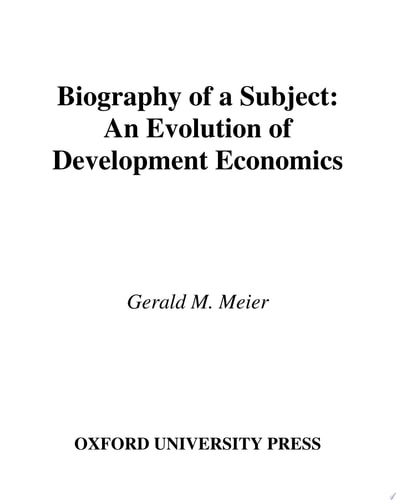
Biography of a Subject: An Evolution of Development Economics
0
0
As an Amazon Associate and affiliate partner, Menrva Books earns from qualifying purchases. Learn more
Author Description
The study of economic development is one of the newest, most exciting, and most challenging branches of the broader discipline of economics and political economy. Although one could claim that Adam Smith was the first "development economist", the systematic study of the problems and processes of economic development in Africa, Asia, and Latin America has emerged only over the past five decades. This biography of the subject of economic development will focus on the essential ideas in the evolution of development thought and policy over the subject's half-century of life. In concise form and avoiding undue technicality, it highlights the influence of development theory on policymaking and on the mixed record of successes and failures in promoting development efforts. The interpretation of theory, policy, and the lessons of experience are covered in three periods: early development economics of the 1950s-60s; orthodox reaction of the 1970s-80s; and the new development economics of the 1980s-90s. Gerald Meier-one of the world's most prominent leading thinkers in the economics of development - interprets the past treatment of development problems with the present and future in mind. He re-interprets the past two generations of development economists in a contemporary voice. And in a forward-looking fashion, the book's perspectives should make the next generation of development problems-and development economists-more intelligible. The reader is invited to consider whether development economists really know how to put matters right.
Menrva's Summary
THE THESIS
This book investigates the intellectual evolution of development economics as a discipline, questioning whether the field has successfully mastered the mechanisms required to foster global economic growth. Gerald M. Meier, a prominent scholar in the field, synthesizes five decades of economic thought, policy shifts, and practical outcomes. He utilizes a historical framework to evaluate how theoretical models from the 1950s through the 1990s influenced real-world policy in Africa, Asia, and Latin America. By re-interpreting past successes and failures, the author aims to provide a clearer trajectory for future economic practitioners.
THE SCOPE MAP
What You Will Find
- A chronological analysis of development economics across three distinct periods: the 1950s-60s, the 1970s-80s, and the 1980s-90s.
- An examination of the interplay between academic theory and government policymaking.
- A critical review of the mixed record of development efforts in emerging economies.
Scope Limits
- The text does not provide a comprehensive technical manual for modern econometric modeling.
- It focuses primarily on the evolution of thought rather than granular case studies of specific local economies.
THE AUTHORITY PERSPECTIVE
Experts recognize this work as a foundational synthesis for understanding the intellectual history of development economics. Readers frequently note that the prose remains accessible while providing a dense, scholarly overview of the field's major paradigm shifts.
Page Count:
249
Publication Date:
2004-01-01
Publisher:
Oxford University Press
ISBN-10:
019029096X
ISBN-13:
9780190290962
Economics
Economic History
Academic
Community Tags
Similar Books