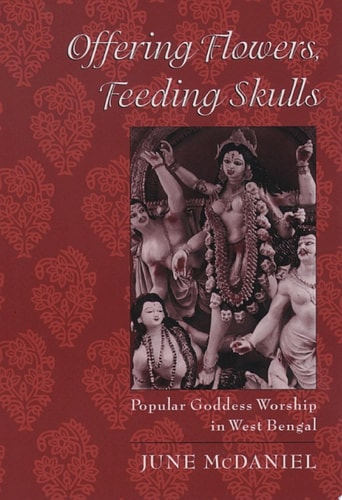
Offering Flowers, Feeding Skulls: Popular Goddess Worship in West Bengal
0
0
As an Amazon Associate and affiliate partner, Menrva Books earns from qualifying purchases. Learn more
Author Description
The Indian state of West Bengal is home to one of the world's most vibrant traditions of goddess worship. The year's biggest holidays are devoted to the goddesses Durga and Kali, with lavish rituals, decorated statues, fireworks, and parades. In Offering Flowers, Feeding Skulls, June McDaniel provides a broad, accessibly written overview of Bengali goddess worship. McDaniel identifies three major forms of goddess worship, and examines each through its myths, folklore, songs, rituals, sacred texts, and practitioners. In the folk/tribal strand, which is found in rural areas, local tribal goddesses are worshipped alongside Hindu goddesses, with an emphasis on possession, healing, and animism. The tantric/yogic strand focuses on ritual, meditation, and visualization as ways of experiencing the power of the goddess directly. The devotional or bhakti strand, which is the most popular form, involves the intense love and worship of a particular form of the goddess. McDaniel traces these strands through Bengali culture and explores how they are interwoven with each other as well as with other forms of Hinduism. She also discusses how these practices have been reinterpreted in the West, where goddess worship has gained the values of sexual freedom and psychological healing, but lost its emphases on devotion and asceticism. Offering Flowers, Feeding Skulls takes the reader inside the lives of practicing Shaktas, including holy women, hymn singers, philosophers, visionaries, gurus, ascetics, healers, musicians, and businessmen, and offers vivid descriptions of their rituals, practices, and daily lives. Drawing on years of fieldwork and extensive research, McDaniel paints a rich, expansive portrait of this fascinating religious tradition.
Menrva's Summary
THE THESIS
This work investigates the diverse manifestations of goddess worship in West Bengal, seeking to categorize the complex interplay between folk, tantric, and devotional traditions. Author June McDaniel, a scholar of religious studies, utilizes extensive ethnographic fieldwork and primary source analysis to construct a framework that organizes these practices into three distinct yet overlapping strands. She argues that understanding these traditions requires examining the lived experiences of practitioners alongside the theological and mythological foundations of the religion.
THE SCOPE MAP
What You Will Find
- A tripartite classification of Bengali goddess worship: folk/tribal, tantric/yogic, and devotional/bhakti.
- Analysis of rituals, myths, folklore, and sacred texts associated with Durga and Kali.
- Qualitative data derived from interviews with holy women, gurus, healers, and lay practitioners.
- A comparative discussion on the reinterpretation of these practices within Western contexts.
Scope Limits
- The study focuses specifically on West Bengal and does not provide a comprehensive survey of goddess worship across all of India.
- The text does not attempt to provide a prescriptive guide for practicing these rituals.
THE AUTHORITY PERSPECTIVE
Scholars and students of South Asian religion frequently cite this book as a foundational text for understanding the practical application of Shaktism in a regional context. Readers often note the clarity of the prose, which balances academic rigor with accessible descriptions of complex ritual life.
Page Count:
364
Publication Date:
2004-01-01
Publisher:
Oxford University Press
ISBN-10:
0190290560
ISBN-13:
9780190290566
Religion
Hinduism
Shaktism
West Bengal
Goddess Worship
Asian Studies
Body Mind Spirit
Anthropology
Community Tags
Similar Books