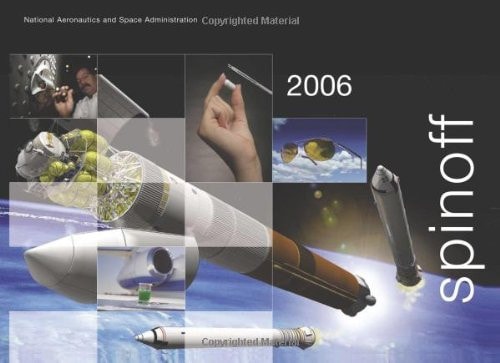
Spinoff 2006
0
0
As an Amazon Associate and affiliate partner, Menrva Books earns from qualifying purchases. Learn more
Author Description
NASA is making significant progress in implementing our Nation's space exploration strategy, which calls for American leadership in exploring other worlds and in the inevitable expansion of human civilization into the cosmos. This past year, NASA engineers developed the Exploration Systems Architecture for the spacecraft and launch vehicles that will enable the renewed human exploration of the Moon, as early as 2018. On August 31, 2006, we announced the selection of Lockheed Martin Corp. as the prime contractor that will build a key element of the architecture, our new Crew Exploration Vehicle Orion. Throughout the year, NASA engaged with potential international, academic, and commercial partners to develop a strategy for scientific, commercial, and exploration activities on the lunar surface, as this next great era of space exploration unfolds. The past year was also marked by the resumption of space shuttle missions, continued productive activity onboard the International Space Station, the launching of the New Horizons mission to Pluto and the CloudSat and CALIPSO Earth-monitoring satellites, the Spitzer Infrared Space Telescope's imaging of a remarkable nest of red supergiant stars-14 supernovas in the making-and the exciting findings of the Cassini spacecraft and Huygens probe in the vicinity of Saturn and its fascinating moons, Titan and Enceladus. When NASA engages in activities such as these, we make discoveries of fundamental scientific importance and we develop new technologies that help improve people's lives. Our investment in exploration is an investment in the highest of high-tech sectors and will help maintain America's position as the preeminent technical nation on Earth. Space exploration is a lens that brings a focus to the development of key technologies in a way that simply would not occur without the "demand pull" that arises when trying to accomplish the near-impossible. To this point, Spinoff 2006 highlights NASA's work, consistent with our Ag
Menrva's Summary
THE THESIS
Spinoff 2006 documents NASA's advancements and their terrestrial applications, showcasing the agency's role in national and international space exploration. The publication details NASA's progress in implementing its space exploration strategy, which includes renewed human exploration of the Moon and expansion into the cosmos. It highlights the selection of Lockheed Martin for the Orion Crew Exploration Vehicle and ongoing collaborations for lunar activities. The year also saw the resumption of space shuttle missions, continued work on the International Space Station, and the launch of missions like New Horizons to Pluto and Earth-monitoring satellites.
THE SCOPE MAP
- Details on the Exploration Systems Architecture for lunar and deep space missions.
- Information on the selection of Lockheed Martin as the prime contractor for the Orion Crew Exploration Vehicle.
- Updates on international, academic, and commercial partnerships for lunar exploration.
- Resumption of space shuttle missions and ongoing activities on the International Space Station.
- Launch of the New Horizons mission to Pluto.
- Deployment of the CloudSat and CALIPSO Earth-monitoring satellites.
- Scientific findings from the Spitzer Infrared Space Telescope, Cassini spacecraft, and Huygens probe.
- Emphasis on the development of new technologies and their impact on improving people's lives.
THE AUTHORITY PERSPECTIVE
This publication serves as an annual report highlighting NASA's technological achievements and their transfer to commercial and public use, demonstrating the agency's commitment to innovation and American leadership in space. It details the progress made in the past year across various missions, from lunar exploration architecture to deep space probes and Earth observation satellites. The report underscores how NASA's investments in exploration drive the development of high-tech sectors and maintain America's technological preeminence. By showcasing the 'demand pull' of ambitious space goals, it illustrates how these endeavors foster critical technological advancements.
Page Count:
144
Publication Date:
2013-12-24
Publisher:
CreateSpace Independent Publishing Platform
ISBN-10:
1494788578
ISBN-13:
9781494788575
Science & Technology
Science
Non-Fiction
Aerospace
Technology
Government Reports
Community Tags
Similar Books