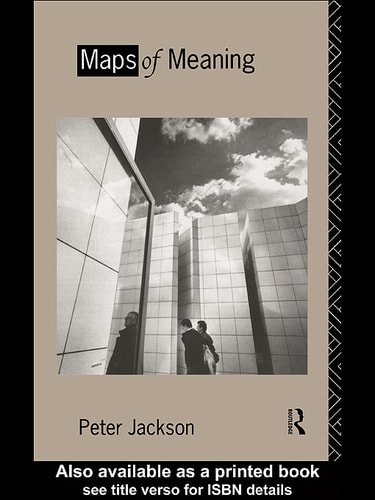
Maps of Meaning
0
0
As an Amazon Associate and affiliate partner, Menrva Books earns from qualifying purchases. Learn more
Author Description
'This is a revealing and intellectually challenging way head for a branch of human geography that has fallen behind other branches in recent decades. The book and the series that it launches deserve more than the usual attention given to new texts for undergraduates. Many of their teachers should find the series interesting, stimulating and even provocative.' - Geography As a geographical introduction to cultural studies, this innovative book marks a significant departure from traditional approaches to cultural geography. Instead of emphasising the evolution of cultural landscapes and the interpretation of past environments, it draws on the literature of contemporary social and cultural theory, focusing on urban as well as rural environments, and on popular culture as well as on vernacular architecture, folk styles and the culture of the elite. `Maps of Meaning' refers to the way we make sense of the world, rendering our geographical experience intelligible, attaching value to the environment and investing the material world with symbolic significance. The book introduces notions of space and place, exploring culture's geographies as well as the geography of culture. It outlines the field of cultural politics, employing concepts of ideology, hegemony and resistance to show how dominant ideologies are contested through unequal relations of power. Culture emerges as a domain in which economic and political contradictions are negotiated and resolved. After a critical review of the work of Carl Sauer and the `Berkeley School' of cultural geography, the book considers the work of such cultural theorists as Raymond Williams, Clifford Geertz and Stuart Hall. It develops a materialist approach to the geographical study of culture, exemplified by studies of class and popular culture, gender and sexuality, race and racism, language and ideology. The book concludes by proposing a new agenda for cultural geography, including a discussion of current debates about post-modernism.
Menrva's Summary
THE THESIS
How can the discipline of cultural geography be reconfigured to better account for the symbolic significance and power dynamics inherent in human environments? Peter Jackson, a prominent human geographer, argues that traditional approaches to the field have become stagnant and overly focused on historical landscape evolution. By integrating contemporary social and cultural theory, he proposes a materialist framework that examines how individuals and societies construct meaning, negotiate power, and contest dominant ideologies within both urban and rural spaces.
THE SCOPE MAP
What You Will Find
- A critical evaluation of the Berkeley School and the legacy of Carl Sauer.
- Theoretical applications of concepts like hegemony, ideology, and resistance to geographical space.
- Interdisciplinary analysis incorporating the work of cultural theorists such as Raymond Williams, Clifford Geertz, and Stuart Hall.
- Case studies exploring the intersections of geography with race, gender, sexuality, and class.
THE AUTHORITY PERSPECTIVE
Experts and academic reviewers recognize this text as a foundational shift in the study of cultural geography, moving the field toward a more critical and theoretically rigorous stance. Readers frequently note the academic density of the prose, which serves as a challenging yet necessary introduction for students and scholars of human geography.
Page Count:
0
Publication Date:
2004-01-01
Publisher:
Taylor & Francis Group Plc
ISBN-10:
0203729471
ISBN-13:
9780203729472
Non-Fiction
Social Theory
Nonfiction
Theorie
Geography
Culture note
Ethnologie
Community Tags
Similar Books