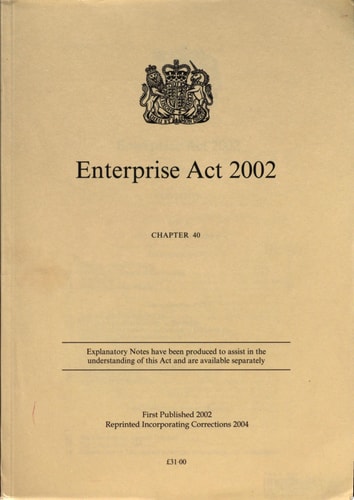
Enterprise Act 2002
0
0
As an Amazon Associate and affiliate partner, Menrva Books earns from qualifying purchases. Learn more
Author Description
The Office of Director General of Fair Trading will be replaced (with effect from 1 April 2003) by the Office of Fair Trading (OFT). New independent competition bodies will take decisions on merger and market investigations using competition-based tests rather than the current public interest test. A maximum penalty of five years in prison will deter individuals who dishonestly operate hardcore cartels. Victims of anti-competitive behaviour will find it easier to bring claims for damages for losses due to anti-competitive behaviour. Stop Now Orders will be extended to protect consumers from traders who do not meet their legal obligations. The OFT will be obliged to respond within 90 days to 'super-complaints' from consumer bodies. In insolvency cases, the use of administrative receivership will be restricted and the balance will be shifted in favour of administration. The Crown's preferential right to recover unpaid taxes ahead of other creditors, will be abolished. Almost all bankrupt individuals will be automatically discharged after a maximum of 12 months. Reforms to the Insolvency Services Account will mean that creditors receive the maximum possible investment return.
Menrva's Summary
THE THESIS
The Enterprise Act 2002 fundamentally reshaped competition and insolvency law in the United Kingdom. This legislation replaced the Office of Director General of Fair Trading with the Office of Fair Trading, empowering new independent bodies to make merger and market investigation decisions based on competition rather than public interest tests. It introduced significant penalties, including up to five years imprisonment for cartel participants, and streamlined processes for victims to claim damages. The Act also extended consumer protection measures and reformed insolvency procedures, restricting administrative receivership and abolishing the Crown's preferential right to recover unpaid taxes.
THE SCOPE MAP
- Establishment of the Office of Fair Trading (OFT) replacing the Office of Director General of Fair Trading.
- Shift to competition-based tests for merger and market investigations by independent bodies.
- Introduction of a maximum five-year prison sentence for individuals involved in hardcore cartels.
- Easier avenues for victims to bring claims for damages due to anti-competitive behaviour.
- Extension of Stop Now Orders for consumer protection against traders failing legal obligations.
- Obligation for the OFT to respond to 'super-complaints' from consumer bodies within 90 days.
- Restriction on the use of administrative receivership and shift towards administration in insolvency cases.
- Abolition of the Crown's preferential right to recover unpaid taxes and automatic discharge for most bankrupt individuals after 12 months.
THE AUTHORITY PERSPECTIVE
The Enterprise Act 2002 is a landmark piece of legislation that significantly modernized UK competition and insolvency law. Its provisions were designed to foster a more competitive market, enhance consumer protection, and create a more efficient insolvency framework. The Act was widely anticipated to bring about substantial changes in how businesses operated and how financial distress was managed, with a focus on fairness and economic efficiency. Its implementation marked a pivotal moment in the evolution of commercial law in the United Kingdom.
Page Count:
453
Publication Date:
2002-01-01
Publisher:
The Stationery Office
ISBN-10:
0105440027
ISBN-13:
9780105440024
Non-Fiction
Legislation
Business Law
Law
Competition Law
Consumer protection
Community Tags
Similar Books