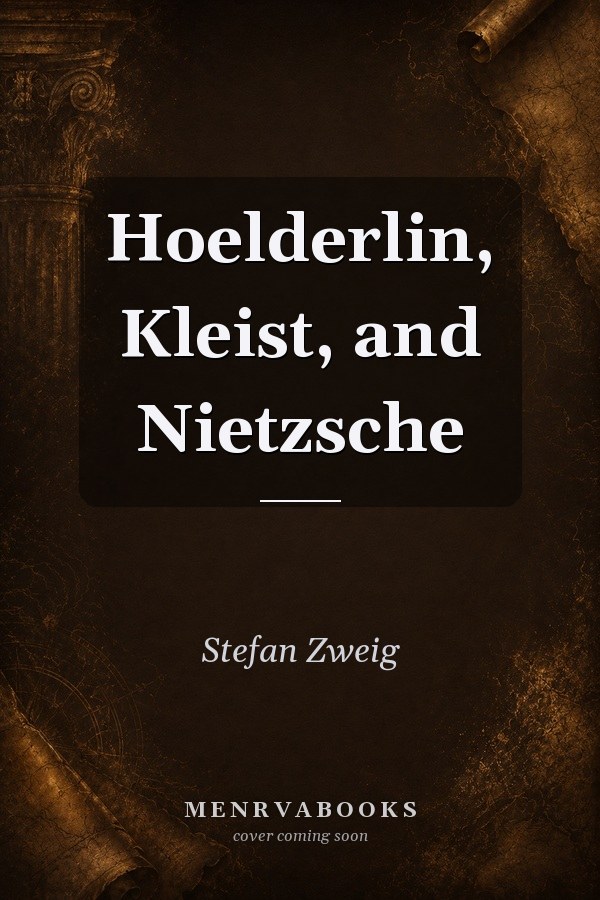
Hoelderlin, Kleist, and Nietzsche
0
0
As an Amazon Associate and affiliate partner, Menrva Books earns from qualifying purchases. Learn more
Author Description
This is the second volume in a trilogy in which Stefan Zweig builds a composite picture of the European mind through intellectual portraits selected from among its most representative and influential figures. In 'Hoelderlin, Kleist, and Nietzsche', Zweig concentrates on three giants of German literature to portray the artist and thinker as a figure possessed by a powerful inner vision at odds with the materialism and scientific positivism of his time, in this case, the nineteenth century. Zweig's subjects here are respectively a lyric poet, a dramatist and writer of novellas, and a philosopher. Each led an unstable life ending in madness and/or suicide and not until the twentieth century did each make their full impact. Whereas the nineteenth-century novel is socially capacious in terms of subject and audience, the three figures treated here are prophets or forerunners of modernist ideas of alienation and exile. Hoelderlin and Kleist consciously opposed the worldly harmoniousness of Goethe's classicism in favor of a visionary inwardness and dramatisation of the subjective psyche. Nietzsche set himself as a destroyer and rebuilder of philosophy and critic of the degradation of the German spirit through nationalism and militarism. Zweig's choice of subjects reflects a division in his own soul. The image of Goethe recurs here as the ultimate upholder of Zweig's own ideals: scientist and artist, receptive to world culture, supremely rational and prudent. Yet Zweig was aware that Hoelderlin, Kleist, and Nietzsche were more daring explorers of the dangerous and destructive aspects of man that needed to be seen and comprehended in the clarifying light of poetry and philosophy.
Menrva's Summary
THE THESIS
This work investigates the psychological and intellectual intersections of three German figures—Hoelderlin, Kleist, and Nietzsche—who existed in a state of profound alienation from their contemporary society. Stefan Zweig, a renowned biographer and essayist, utilizes his deep knowledge of European intellectual history to construct a composite portrait of these men. He argues that their lives, marked by instability and eventual tragedy, served as necessary precursors to the modernist preoccupation with the subjective psyche and the rejection of nineteenth-century materialism.
THE SCOPE MAP
What You Will Find
- Biographical analysis of Friedrich Hoelderlin, Heinrich von Kleist, and Friedrich Nietzsche.
- A comparative study of the tension between visionary inwardness and the classicism of Goethe.
- Examination of the themes of exile, madness, and the rejection of scientific positivism.
- Historical context regarding the development of German philosophy and literature in the nineteenth century.
THE AUTHORITY PERSPECTIVE
Critics frequently observe that Zweig provides a highly subjective and empathetic reading of his subjects, prioritizing psychological insight over rigid academic documentation. Scholars often highlight this text as a significant contribution to the study of the European intellectual tradition and the evolution of the modernist spirit.
Page Count:
0
Publication Date:
2017-01-01
Publisher:
Taylor & Francis Group
ISBN-10:
020378992X
ISBN-13:
9780203789926
Biography
Philosophy
History
Literary Criticism
European
Fiction