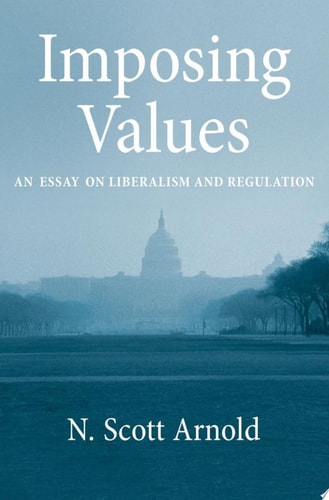
Imposing Values: Liberalism and Regulation
0
0
As an Amazon Associate and affiliate partner, Menrva Books earns from qualifying purchases. Learn more
Author Description
A major question for liberal politics and liberal political theory concerns the proper scope of government. Liberalism has always favored limited government, but there has been wide-ranging dispute among liberals about just how extensive the scope of government should be. Included in this dispute are questions about the extent of state ownership of the means of production, redistribution of wealth and income through the tax code and transfer programs, and the extent of government regulation. One of N. Scott Arnold's goals is to give an accurate characterization of both modern liberalism and classical liberalism, explaining along the way why libertarianism is not the only form that classical liberalism can take. The main focus of Arnold's book, however, concerns regulation--specifically, the modern liberal regulatory agenda as it has taken shape in contemporary American society. This is the set of regulatory regimes favored by all modern liberals and opposed by all classical liberals. It includes contemporary employment law in all its manifestations, health and safety regulation, and land use regulation. The heart of the book consists of a systematic evaluation of arguments for and against all the items on this agenda. It turns out that there are good arguments on both sides for most of these regulatory regimes. Because of this, and because someone's vision of the proper scope of government will ultimately prevail, some procedural requirements that all liberals could agree to must be satisfied for one side to impose legitimately its values on the polity at large. These procedural requirements are identified, argued for, and then applied to the elements of the modern liberal regulatory agenda. Arnold argues that many, though not all, of these elements have been illegitimately imposed on American society.
Menrva's Summary
THE THESIS
This book investigates the legitimate scope of government regulation within the framework of liberal political theory. N. Scott Arnold, a scholar of political philosophy, evaluates the modern liberal regulatory agenda by contrasting it with classical liberal principles. He argues that because valid arguments exist on both sides of regulatory debates, specific procedural requirements must be met before one group can legitimately impose its values on the broader polity.
THE SCOPE MAP
What You Will Find
- A systematic evaluation of contemporary employment, health, safety, and land use regulations.
- A comparative analysis of modern liberalism, classical liberalism, and libertarianism.
- A proposed set of procedural requirements for the legitimate implementation of state policy.
Scope Limits
- The analysis is primarily focused on the regulatory landscape of contemporary American society.
- The text does not provide an exhaustive history of all liberal political thought, focusing instead on the specific regulatory agenda.
THE AUTHORITY PERSPECTIVE
Scholars and students of political philosophy frequently note the rigorous, systematic approach Arnold takes in evaluating competing regulatory arguments. The text is recognized as a significant contribution to the discourse on the limits of state power and the procedural requirements of a liberal democracy.
Page Count:
504
Publication Date:
2009-01-01
Publisher:
Oxford University Press
ISBN-10:
0190452021
ISBN-13:
9780190452025
Philosophy
Law
Deregulation
Government Regulation
Liberalism
Political Philosophy
Public Policy
Community Tags
Similar Books