
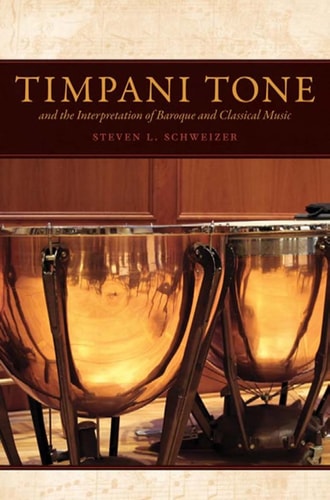
Timpani Tone and the Interpretation of Baroque and Classical Music
0
0
As an Amazon Associate and affiliate partner, Menrva Books earns from qualifying purchases. Learn more
Author Description
Timpani Tone and the Interpretation of Baroque and Classical Music explores the nature, production, and evolution of timpani tone and provides insights into how to interpret the music of J. S. Bach, Handel, Haydn, and Mozart. In drawing on 31 years of experience, Steven L. Schweizer focuses on the components of timpani tone and methods for producing it. In so doing, he discusses the importance of timpani bowl type; mallets; playing style; physical gestures; choice of drums; mallet grip; legato, marcato, and staccato strokes; playing different parts of the timpano head; and psychological openness to the music in effectively shaping and coloring timpani parts. In an acclaimed chapter on interpretation, Schweizer explores how timpanists can use knowledge of the composer's style, psychology, and musical intentions; phrasing and articulation; the musical score; and a conductor's gestures to effectively and convincingly play a part with emotional dynamism and power. The greater part of the book is devoted to the interpretation of Baroque and Classical orchestral and choral music. Meticulously drawing on original sources and authoritative scores from the seventeenth through nineteenth centuries, Schweizer convincingly demonstrates that timpanists were capable of producing a broader range of timpani tone earlier than is normally supposed. The increase in timpani size, covered timpani mallets, and thinner timpani heads increased the quality of timpani tone; therefore, today's timpanist's need not be entirely concerned with playing with very articulate sticks. In exhaustive sections on Bach, Handel, Haydn, and Mozart, Schweizer takes the reader on an odyssey through the interpretation of their symphonic and choral music. Relying on Baroque and Classical performance practices, timpani notation, the composer's musical style, and definitive scores, he interprets timpani parts from major works of these composers. Schweizer pays particular attention to timpani tone, articulation,
Menrva's Summary
THE THESIS
This book investigates the technical and aesthetic requirements for producing high-quality timpani tone while providing a framework for interpreting Baroque and Classical orchestral works. Author Steven L. Schweizer, drawing on over three decades of professional experience, argues that historical timpanists possessed a greater range of tonal capability than modern scholarship often acknowledges. He presents a methodology that integrates physical technique, equipment selection, and deep stylistic analysis of composers such as Bach, Handel, Haydn, and Mozart to achieve musical dynamism.
THE SCOPE MAP
What You Will Find
- Analysis of equipment variables including bowl types, mallet selection, and head thickness.
- Technical instruction on stroke types, grip, and playing positions on the timpano head.
- Interpretive strategies based on historical performance practices and composer psychology.
- Detailed examinations of timpani parts in major symphonic and choral works.
Scope Limits
- The text focuses specifically on the Baroque and Classical eras, excluding later Romantic or contemporary percussion techniques.
- It does not serve as a general beginner's manual for percussion, assuming a baseline of technical proficiency.
THE AUTHORITY PERSPECTIVE
Experts and professional percussionists recognize this work as a significant contribution to the study of historical performance practice. Readers frequently note the technical density of the prose, which serves as a specialized resource for advanced students and orchestral professionals.
Page Count:
209
Publication Date:
2010-01-01
Publisher:
Oxford University Press
ISBN-10:
0190453257
ISBN-13:
9780190453251
Music
Performance Practice
Music theory
Choral
Percussion
Baroque Music
Music
Humanities
Kettledrum
Community Tags
Other Editions(3)

Similar Books







Reader Comments
Share Your Thoughts
No comments yet. Be the first to share your thoughts!