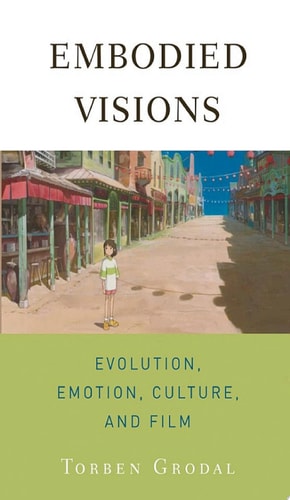
Embodied Visions: Evolution, Emotion, Culture, and Film
0
0
As an Amazon Associate and affiliate partner, Menrva Books earns from qualifying purchases. Learn more
Author Description
Embodied Visions presents a groundbreaking analysis of film through the lens of bioculturalism, revealing how human biology as well as human culture determine how films are made and experienced. Throughout his study, Torben Grodal uses the breakthroughs of modern brain science to explain central features of film aesthetics and to construct a general model of aesthetic experience-what he terms the PECMA flow model-that demonstrates the movement of information and emotions in the brain when viewing film. Examining a wide array of genres-animation, romance, pornography, fantasy, horror-from evolutionary and psychological perspectives, Grodal also reflects on social issues at the intersection of film theory and neuropsychology. These include moral problems in film viewing, how we experience realism and character identification, and the value of the subjective forms that cinema uniquely elaborates.
Menrva's Summary
THE THESIS
How do human biological evolution and cultural conditioning interact to shape the creation and reception of cinematic experiences? Torben Grodal, a scholar in film studies, synthesizes findings from modern neuroscience and evolutionary psychology to propose a comprehensive framework for understanding aesthetic response. He introduces the PECMA flow model, which maps the cognitive and emotional processing of information as it moves through the brain during film viewing. By bridging the gap between biological imperatives and cultural expression, Grodal argues that film aesthetics are grounded in universal human neurobiology.
THE SCOPE MAP
What You Will Find
- The PECMA flow model for tracking information and emotional processing in the brain.
- Evolutionary and psychological analysis of diverse genres including animation, romance, pornography, fantasy, and horror.
- Discussion on moral implications, character identification, and the nature of realism in cinema.
Scope Limits
- The text does not provide a historical survey of film production techniques.
- It does not focus on sociological critiques of the film industry or political economy.
THE AUTHORITY PERSPECTIVE
Scholars and students of film theory frequently cite this work as a foundational text for integrating cognitive science into aesthetic analysis. Readers often note the academic density of the prose, which requires a foundational understanding of both film studies and neuropsychological terminology.
Page Count:
332
Publication Date:
2009-01-01
Publisher:
Oxford University Press
ISBN-10:
0190451645
ISBN-13:
9780190451646
Media Studies
Film Theory
Aesthetics
Psychological aspects
Allied Health
Bioculturalism
Medical
Community Tags
Similar Books