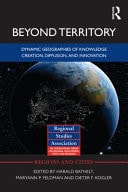
Beyond Territory: Dynamic Geographies of Innovation and Knowledge Creation
0
0
As an Amazon Associate and affiliate partner, Menrva Books earns from qualifying purchases. Learn more
Author Description
The main purpose of the book is to discuss new trends in the dynamic geography of innovation and argue that in an era of increasing globalization, two trends seem quite dominant: rigid territorial models of innovation, and localized configurations of innovative activities. The book brings together scholars who are working on these topics. Rather than focusing on established concepts and theories, the book aims to question narrow explanations, rigid territorializations, and simplistic policy frameworks; it provides evidence that innovation, while not exclusively dependent on regional contexts, can be influenced by place-specific attributes. The study of innovation encompasses an increasingly wide and rich field of conceptual and empirical studies and debates, which span across disciplinary boundaries in the social sciences. This book identifies the key debates, new streams of inquiry and progress in research related to the transfer, circulation and generation of knowledge in a spatial perspective. The book is organized into three subheadings: place-specific aspects of specialization and diversity; evolutionary spatio-sectoral dynamics; and bridging the local and the global divide. It is the aggregate of all of these contributions that offers an exclusive insight into the dynamic geographies of knowledge creation, diffusion and innovation, well beyond the traditional territorial approach. This volume contains new empirical and conceptual work by an interdisciplinary group of leading scholars from areas such as economic geography, innovation studies, and political science
Menrva's Summary
THE THESIS
This book investigates how innovation and knowledge creation transcend rigid territorial boundaries in an increasingly globalized economic landscape. The authors, Dieter F. Kogler, Harald Bathelt, and Maryann P. Feldman, curate a collection of interdisciplinary research that challenges traditional, place-bound models of economic development. By synthesizing empirical studies from economic geography, innovation studies, and political science, the text argues that while place-specific attributes remain relevant, they must be understood within a broader, more fluid framework of global knowledge circulation.
THE SCOPE MAP
What You Will Find
- Analysis of place-specific aspects of economic specialization and industrial diversity.
- Examination of evolutionary spatio-sectoral dynamics in knowledge generation.
- Frameworks for bridging the divide between local innovation clusters and global networks.
- Empirical evidence questioning simplistic policy frameworks regarding regional innovation.
THE AUTHORITY PERSPECTIVE
Experts identify this volume as a significant contribution to the field of economic geography, noting its success in moving beyond traditional cluster theories. Readers frequently highlight the academic density of the prose, which serves as a rigorous resource for scholars and policymakers interested in the spatial dimensions of innovation.
Page Count:
256
Publication Date:
2012-01-01
Publisher:
Taylor & Francis Group
ISBN-10:
0203814878
ISBN-13:
9780203814871
Economics
Geography
Innovation
Globalization
Social Science
Community Tags
Similar Books