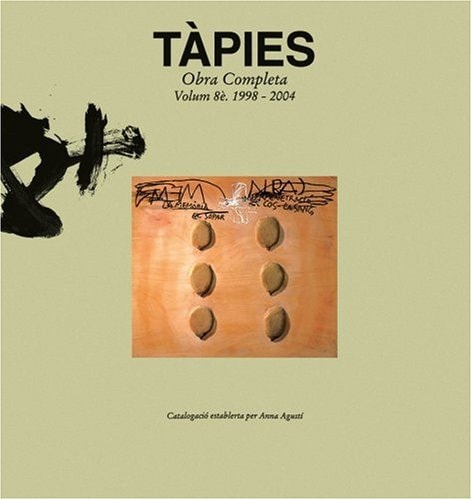
Tàpies obra completa. 1998-2004. 8
0
0
As an Amazon Associate and affiliate partner, Menrva Books earns from qualifying purchases. Learn more
Author Description
As a young man, Antoni Tapies set out to study law; less than two years later, he had declared himself a painter. Born in 1923, he dabbled in Surrealism under the influence of Paul Klee and Joan Miro but soon become an Abstract Expressionist, first in the context of Arte Povera and then as an early--defining--practitioner of mixed media, stirring clay and marble dust into his work and adding cloth, string and paper. He became one of Spain's greatest artists, and one of his generation's greatest, winner of the Venice Biennale's Golden Lion and the subject of Guggenheim and Jeu de Paume retrospectives. This eighth volume of his catalogue raisonne assembles his most recent work, from 1998 to 2004. In recent years he has consolidated and condensed an artistic language that expresses in visual terms, first, his conception of art, and second, intimate philosophical concerns to which he has returned with the passage of time. His forms, despite their ductility, remain faithful to their origins: these works are at once of the moment, of the contemporary world, and a record, an analysis, of his career.
Menrva's Summary
THE THESIS
This volume documents the artistic output of Antoni Tàpies from 1998 to 2004, a period of consolidation and refinement in his career. The book details Tàpies's late works, showcasing how he continued to explore his unique visual language, blending abstract expressionism with mixed media techniques. It examines his philosophical concerns and how they are visually represented in his art, demonstrating a consistent artistic vision rooted in his early influences and evolving throughout his prolific career. The works presented are a testament to his enduring artistic philosophy and his engagement with the contemporary world.
THE SCOPE MAP
- A comprehensive catalog of Antoni Tàpies's artworks created between 1998 and 2004.
- Detailed reproductions of paintings, sculptures, and mixed-media pieces from his later career.
- Analysis of Tàpies's evolving artistic language and philosophical themes during this period.
- Insights into his signature techniques, including the use of unconventional materials like clay and marble dust.
- Contextualization of these works within the broader scope of Tàpies's artistic development and legacy.
- Information on the Venice Biennale's Golden Lion and Guggenheim retrospectives, highlighting his critical acclaim.
THE AUTHORITY PERSPECTIVE
This eighth volume of Tàpies's catalogue raisonné assembles his most recent work, from 1998 to 2004. In recent years he has consolidated and condensed an artistic language that expresses in visual terms, first, his conception of art, and second, intimate philosophical concerns to which he has returned with the passage of time. His forms, despite their ductility, remain faithful to their origins: these works are at once of the moment, of the contemporary world, and a record, an analysis, of his career. The book serves as a crucial reference for understanding the final phase of one of Spain's greatest artists.
Page Count:
510
Publication Date:
2005-01-01
Publisher:
Polígrafa
ISBN-10:
8488786832
ISBN-13:
9788488786838
Biography
Non-Fiction
Art
Art History
Community Tags
Similar Books