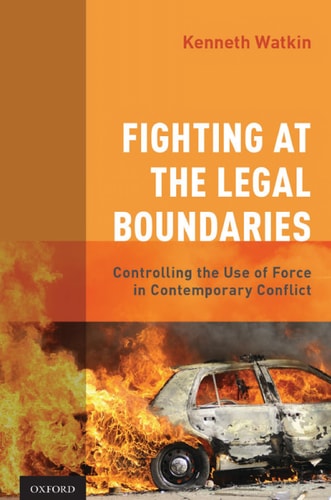
Fighting at the Legal Boundaries: Controlling the Use of Force in Contemporary Conflict
0
0
As an Amazon Associate and affiliate partner, Menrva Books earns from qualifying purchases. Learn more
Author Description
The international law governing armed conflict is at a crossroads, as the formal framework of laws designed to control the exercise of self-defense and conduct of inter-state conflict finds itself confronted with violent 21st Century disputes of a very different character. Military practitioners who seek to stay within the bounds of international law often find themselves applying bodies of law-IHRL, IHL, ICL-in an exclusionary fashion, and adherence to those boundaries can lead to a formal and often rigid application of the law that does not adequately address contemporary security challenges. Fighting at the Legal Boundaries offers a holistic approach towards the application of the various constitutive parts of international law. The author focuses on the interaction between the applicable bodies of law by exploring whether their boundaries are improperly drawn, or are being interpreted in too rigid a fashion. Emphasis is placed on the disconnect that can occur between theory and practice regarding how these legal regimes are applied and interact with one another. Through a number of case studies, Fighting at the Legal Boundaries explores how the threat posed by insurgents, terrorists, and transnational criminal gangs often occurs not only at the point where these bodies of law interact, but also in situations where there is significant overlap. In this regard, the exercise of the longstanding right of States to defend nationals, including the conduct of operations such as hostage rescue, can involve the application of human rights based law enforcement norms to counter threats transcending the conflict spectrum. This book has five parts: Part I sets out the security, legal, and operational challenges of contemporary conflict. Part II focuses on the interaction between the jus ad bellum, humanitarian law and human rights, including an analysis of the historical influences that shaped their application as separate bodies of law. Emphasis is placed on the influence
Menrva's Summary
THE THESIS
This work investigates whether the rigid, exclusionary application of international legal frameworks—specifically International Humanitarian Law, International Human Rights Law, and International Criminal Law—fails to address the complexities of 21st-century armed conflict. Kenneth Watkin, a former military legal officer, utilizes his extensive experience to argue that current legal boundaries are often drawn or interpreted in ways that create a disconnect between theoretical law and operational reality. He proposes a holistic approach that examines how these distinct legal regimes interact, particularly when confronting non-state actors like insurgents and transnational criminal organizations.
THE SCOPE MAP
What You Will Find
- Analysis of the intersection between jus ad bellum, humanitarian law, and human rights law.
- Examination of operational challenges posed by terrorists, insurgents, and criminal gangs.
- Case studies regarding the use of force in hostage rescue and self-defense operations.
- A five-part structural framework addressing security, legal, and operational dimensions.
Scope Limits
- The text does not provide a comprehensive history of all international treaties but focuses specifically on the application of force.
- It does not offer a definitive legislative solution but rather a methodology for legal interpretation.
THE AUTHORITY PERSPECTIVE
Legal scholars and military practitioners frequently cite this text as a sophisticated analysis of the friction between traditional legal silos and modern security threats. Experts highlight the book as a necessary resource for understanding the practical application of law in complex, multi-dimensional conflict environments.
Page Count:
726
Publication Date:
2016-01-01
Publisher:
Oxford University Press
ISBN-10:
0190457996
ISBN-13:
9780190457990
International Law
Military Law
Professional Career & Trade
Armed conflict
Security Studies
Human rights
Community Tags
Similar Books