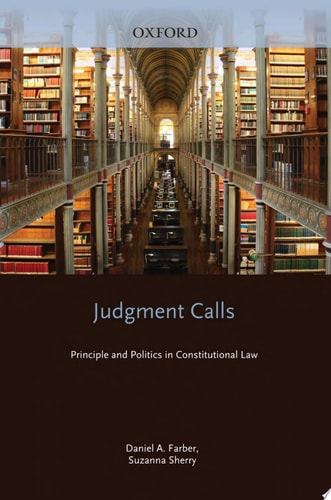
Judgment Calls: Principle and Politics in Constitutional Law
0
0
As an Amazon Associate and affiliate partner, Menrva Books earns from qualifying purchases. Learn more
Author Description
Judgement Calls tackles one of the most important and controversial legal questions in contemporary America: How should judges interpret the Constitution? Our Constitution contains a great deal of language that is vague, broad, or ambiguous, making its meaning uncertain. Many people believe this uncertainty allows judges too much discretion. They suggest that constitutional adjudication is just politics in disguise, and that judges are legislators in robes who read the Constitution in accordance with their own political views. Some think that political decision making by judges is inevitable, and others think it can be restrained by "strict constructionist" theories like textualism or originalism. But at bottom, both sorts of thinkers believe that judging has to be either tightly constrained and inflexible or purely political and unfettered: There is, they argue, no middle ground. Farber and Sherry disagree, and in this book they describe and defend that middle ground. They show how judging can be--and often is--both principled and flexible. In other words, they attempt to reconcile the democratic rule of law with the recognition that judges have discretion. They explain how judicial discretion can be exercised responsibly, describe the existing constraints that guide and cabin such discretion, and suggest improvements. In exploring how constitutional adjudication works in practice (and how it can be made better), Farber and Sherry cover a wide range of topics that are relevant to their thesis and also independently important, including judicial opinion-writing, the use of precedent, the judicial selection process, the structure of the American judiciary, and the nature of legal education. They conclude with a careful look at how the Supreme Court has treated three of the most significant and sensitive constitutional issues: terrorism, abortion, and affirmative action. Timely, trenchant, and carefully argued, Judgment Calls is a welcome addition to the literature on
Menrva's Summary
THE THESIS
This book investigates whether constitutional adjudication must be either strictly constrained by originalism or purely political, arguing instead for a principled middle ground. Daniel A. Farber and Suzanna Sherry, both distinguished legal scholars, utilize their extensive expertise in constitutional law to challenge the binary view of judicial decision-making. They propose a framework where judicial discretion is exercised responsibly within existing institutional and professional constraints, aiming to reconcile the rule of law with the reality of judicial interpretation.
THE SCOPE MAP
What You Will Find
- Analysis of judicial opinion-writing and the application of legal precedent
- Examination of the judicial selection process and the structure of the American judiciary
- Critique of textualism and originalism as rigid interpretative theories
- Case studies on Supreme Court rulings regarding terrorism, abortion, and affirmative action
Scope Limits
- The text does not provide a comprehensive history of all constitutional amendments
- It does not offer a manual for litigation strategy or trial advocacy
THE AUTHORITY PERSPECTIVE
Legal scholars and practitioners frequently cite this work for its balanced approach to the debate over judicial discretion. Experts highlight the text as a sophisticated contribution to constitutional theory that remains accessible to those interested in the mechanics of the American legal system.
Page Count:
217
Publication Date:
2008-01-01
Publisher:
Oxford University Press
ISBN-10:
0190451637
ISBN-13:
9780190451639
Non-Fiction
Law
United States
Constitutional Law
Interpretation and construction
American Government
Professional Career & Trade
Community Tags
Similar Books













Reader Comments
Share Your Thoughts
No comments yet. Be the first to share your thoughts!