The Integration of European Financial Markets: The Regulation of Monetary Obligations
0
0
As an Amazon Associate and affiliate partner, Menrva Books earns from qualifying purchases. Learn more
Author Description
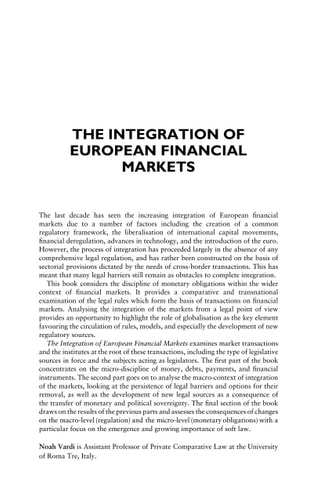
The last decade has seen the increasing integration of European financial markets due to a number of factors including the creation of a common regulatory framework, the liberalisation of international capital movements, financial deregulation, advances in technology and the introduction of the Euro. However, the process of integration has proceeded largely in the absence of any comprehensive legal regulation, and has rather been constructed on the basis of sectorial provisions dictated by the needs of cross-border transactions. This has meant that many legal barriers still remain as obstacles to complete integration.This book considers the discipline of monetary obligations within the wider context of financial markets. The book provides a comparative and transnational examination of the legal rules which form the basis of transactions on financial markets. Analysing the integration of the markets from a legal point of view provides an opportunity to highlight the role of globalisation as the key element favouring the circulation of rules, models, and especially the development of new regulatory sources.The book examines market transactions and the institutes at the root of these transactions, including the type of legislative sources in force and the subjects acting as legislators. The first part of the book concentrates on the micro-discipline of money, debts, payments and financial instruments. The second part goes on to analyse the macro-context of integration of the markets, looking at the persistence of legal barriers and options for their removal, as well as the development of new legal sources as a consequence of the transfer of monetary and political sovereignty. Finally, the book draws links between the two parts and assesses the consequences of the changes at the macro-level of regulation on the micro-level of legal discipline of monetary obligations, particularly focusing on the emergence and growing importance of soft law.
Menrva's Summary
THE THESIS
This book investigates the legal challenges and regulatory gaps inherent in the integration of European financial markets, specifically focusing on the discipline of monetary obligations. Noah Vardi, an expert in financial law, utilizes a comparative and transnational framework to analyze how sectorial provisions and the absence of comprehensive regulation hinder market unification. The text argues that the shift toward globalization and the introduction of the Euro necessitate a re-evaluation of how legal rules are developed and applied across borders.
THE SCOPE MAP
What You Will Find
- A comparative analysis of legal rules governing money, debts, payments, and financial instruments.
- An examination of the macro-context of market integration and the persistence of legal barriers to cross-border transactions.
- A study of the emergence and growing influence of soft law in the regulation of financial markets.
- An assessment of how the transfer of monetary and political sovereignty impacts the micro-level legal discipline of obligations.
THE AUTHORITY PERSPECTIVE
Legal scholars and financial practitioners frequently cite this work for its detailed examination of the intersection between monetary policy and private law. Experts highlight the text as a foundational resource for understanding the complexities of regulatory harmonization within the European Union.
Page Count:
208
Publication Date:
2011-01-01
Publisher:
Routledge-Cavendish
ISBN-10:
0203834089
ISBN-13:
9780203834084
Economics
International Law
Law
Capital market
European Union
Money
Finance
Community Tags
Similar Books