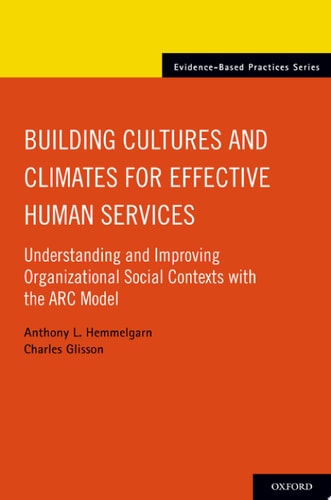
Building Cultures and Climates for Effective Human Services
0
0
As an Amazon Associate and affiliate partner, Menrva Books earns from qualifying purchases. Learn more
Author Description
It Is Widely Acknowledged That Many Healthcare, Behavioral Health, And Social Service Organizations Provide Less-than-optimal Services And That The Challenge Of Improving Services Depends On Successfully Changing Organizational Culture And Climate. However, There Are Almost No Organizational-level Strategies That Have Been Tested With Randomized Controlled Trials. Building Cultures And Climates For Effective Human Services Addresses The Need For Evidence-based Organizational Strategies For Improving Human Service Quality And Outcomes By Uniquely Describing The Authors' Own Case Examples, Nationwide Studies, And Randomized Controlled Trials To Explain How Organizational Culture And Climate Can Be Assessed And Changed. The Two Authors Use Their Decades Of Research And Practice Experience In Assessing And Changing Human Service Organizations To Explain How Organizations Can Improve The Services They Provide Using The Authors' Arc Model, Which Effectively Removes Service Barriers And Supports The Implementation Of Evidence-based Practices And Other Innovations. The Book Also Blends Case Examples With Research From Nationwide Studies, Regional Experiments, And Randomized Controlled Trials To Explain The Arc Model Of Organizational Effectiveness And How It Works To Improve Services. It Provides A Balance Between Theory, Empirical Research, And Actual Case Examples To Help Researchers, Organizational Consultants, Administrators, And Service Providers Gain A Practical Understanding Of How Culture And Climate Affect Services And How They Can Be Improved. Furthermore, The Text Describes The Three Arc Strategies, Each Composed Of Multiple Elements, To: (1) Embed Key Organizational Principles, (2) Implement Core Organizational Component Tools, And (3) Apply Mental Models To Alter Shared Reasoning And Beliefs That Affect Success. No Other Organizational-level Strategies For Improving Services Have Been So Well Documented And Tested.
Menrva's Summary
THE THESIS
This book investigates how organizational culture and climate directly influence the quality of human services and provides a tested framework for systemic improvement. Authors Anthony L. Hemmelgarn and Charles Glisson draw upon decades of research, including nationwide studies and randomized controlled trials, to present the ARC (Availability, Responsiveness, and Continuity) model. The text argues that improving service outcomes requires deliberate, evidence-based strategies to alter the shared beliefs and operational structures within behavioral health and social service organizations.
THE SCOPE MAP
What You Will Find
- The ARC model framework for organizational effectiveness.
- Strategies for embedding organizational principles and core component tools.
- Application of mental models to shift shared reasoning and beliefs.
- Empirical data derived from randomized controlled trials in human services.
Scope Limits
- The text focuses specifically on human service, behavioral health, and healthcare organizations rather than general corporate or private sector business environments.
THE AUTHORITY PERSPECTIVE
Experts recognize this work as a rare, evidence-based contribution to the field of organizational change in social services. Readers frequently note the practical utility of the ARC model for administrators and consultants seeking to move beyond theoretical management concepts.
Page Count:
240
Publication Date:
2018-01-01
Publisher:
Oxford University Press
ISBN-10:
0190455292
ISBN-13:
9780190455293
Professional Development
Public Administration
Community Tags
Similar Books