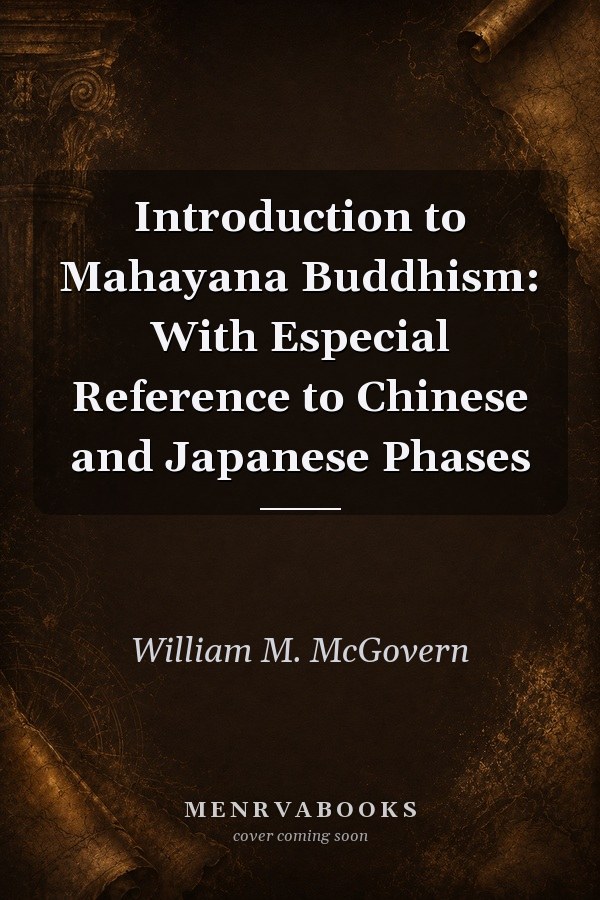
Introduction to Mahayana Buddhism: With Especial Reference to Chinese and Japanese Phases
0
0
As an Amazon Associate and affiliate partner, Menrva Books earns from qualifying purchases. Learn more
Author Description
William Montgomery McGovern’s Introduction to Mahayana Buddhism was one of the first books on Mahayana Buddhism written for a Western audience. It predates influential English language overviews of Buddhism by D. T. Suzuki, A. Watts, and W. Rahula. The author was born in New York City in 1897 and spent his latter teenage years (1914-1917) training at the Nishi Hongwanji Mahayana Buddhist monastery in Kyoto, Japan. He founded the Mahayana Association at age eighteen and edited and published the journal "Mahayanist" while completing his studies at the monastery. Introduction to Mahayana Buddhism was written as part of a thesis which secured him his Buddhist degree and an honorary ordination as a Buddhist priest. Intended as a simplified and introductory text for a lay audience, the book reflects the unique perspective of a Westerner trained in Japan at a time when Mahayana Buddhism was little known in the West. Referencing Buddhist literature, it gives a short history of Buddhism and the divergence of schools of Buddhist philosophy, introduces the four noble truths, the philosophy of Karma, the nature of Buddhahood, reincarnation and the road to nirvana, Buddhist cosmology, and psychological and philosophical elements of Buddhist teachings. Although the divisions of non Mahayana Buddhist sects and philosophy described may be considered dated, Introduction to Mahayana Buddhism remains significant for its historical value in presenting Eastern religious and philosophical thought to Westerners at a pivotal time in history.
Menrva's Summary
THE THESIS
This text investigates the foundational principles and historical development of Mahayana Buddhism to provide a comprehensive introduction for Western readers. William M. McGovern, drawing upon his direct training at the Nishi Hongwanji monastery in Kyoto, synthesizes complex theological concepts into an accessible framework. He utilizes his unique position as a Westerner ordained in the tradition to bridge the gap between Eastern monastic scholarship and the curiosity of the early 20th-century lay public.
THE SCOPE MAP
What You Will Find
- Historical overview of the divergence of Buddhist schools and philosophical sects.
- Explanations of core doctrines including the Four Noble Truths and the philosophy of Karma.
- Analysis of Buddhist cosmology and the metaphysical nature of Buddhahood.
- Examination of the psychological and philosophical underpinnings of the path to nirvana.
THE AUTHORITY PERSPECTIVE
While some of the specific sectarian classifications are now considered dated by modern scholars, the text remains a significant historical document for its early role in introducing Mahayana thought to the West. Experts recognize the work as a foundational, albeit early, effort that predates many of the more widely known 20th-century English-language surveys of the tradition.
Page Count:
244
Publication Date:
2010-01-01
Publisher:
Taylor & Francis Group
ISBN-10:
0203843487
ISBN-13:
9780203843482
History
Religion
Philosophy
Buddhism
Eastern Philosophy
Community Tags
Similar Books