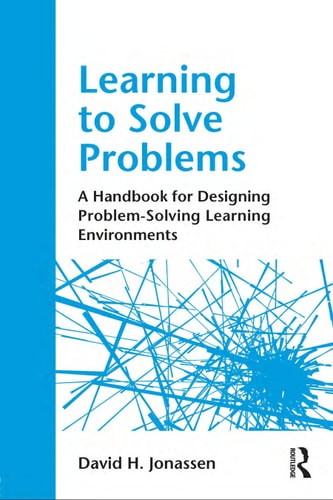
Learning to Solve Problems: A Handbook for Designing Problem-Solving Learning Environments
0
0
As an Amazon Associate and affiliate partner, Menrva Books earns from qualifying purchases. Learn more
Author Description
This Book Provides A Comprehensive, Up-to-date Look At Problem Solving Research And Practice Over The Last Fifteen Years. The First Chapter Describes Differences In Types Of Problems, Individual Differences Among Problem-solvers, As Well As The Domain And Context Within Which A Problem Is Being Solved. Part One Describes Six Kinds Of Problems And The Methods Required To Solve Them. Part Two Goes Beyond Traditional Discussions Of Case Design And Introduces Six Different Purposes Or Functions Of Cases, The Building Blocks Of Problem-solving Learning Environments. It Also Describes Methods For Constructing Cases To Support Problem Solving. Part Three Introduces A Number Of Cognitive Skills Required For Studying Cases And Solving Problems. Finally, Part Four Describes Several Methods For Assessing Problem Solving. Key Features Includes: Teaching Focus – The Book Is Not Merely A Review Of Research. It Also Provides Specific Research-based Advice On How To Design Problem-solving Learning Environments. Illustrative Cases – A Rich Array Of Cases Illustrates How To Build Problem-solving Learning Environments. Part Two Introduces Six Different Functions Of Cases And Also Describes The Parameters Of A Case. Chapter Integration – Key Theories And Concepts Are Addressed Across Chapters And Links To Other Chapters Are Made Explicit. The Idea Is To Show How Different Kinds Of Problems, Cases, Skills, And Assessments Are Integrated. Author Expertise – A Prolific Researcher And Writer, The Author Has Been Researching And Publishing Books And Articles On Learning To Solve Problems For The Past Fifteen Years. This Book Is Appropriate For Advanced Courses In Instructional Design And Technology, Science Education, Applied Cognitive Psychology, Thinking And Reasoning, And Educational Psychology. Instructional Designers, Especially Those Involved In Designing Problem-based Learning, As Well As Curriculum Designers Who Seek New Ways Of Structuring Curriculum Will Find It An Invaluable Refe
Menrva's Summary
THE THESIS
This book investigates the theoretical frameworks and practical methodologies required to design effective problem-solving learning environments. David H. Jonassen, a prominent researcher in instructional technology, synthesizes fifteen years of empirical research to provide a structured approach to curriculum development. The text argues that by categorizing problem types and understanding the cognitive requirements of learners, educators can construct more robust environments that foster critical thinking and analytical skills.
THE SCOPE MAP
What You Will Find
- A taxonomy of six distinct problem types and their corresponding solution methods.
- A framework for utilizing cases as foundational building blocks in instructional design.
- Research-based strategies for assessing student performance in problem-solving tasks.
- Methodologies for integrating cognitive skill development into curriculum design.
THE AUTHORITY PERSPECTIVE
Experts in instructional design and educational psychology recognize this work as a foundational text for practitioners and graduate students. Readers frequently note the academic density of the prose, which serves as a comprehensive reference for those tasked with structuring complex learning environments.
Page Count:
437
Publication Date:
2011-01-01
Publisher:
Routledge
ISBN-10:
0203847520
ISBN-13:
9780203847527
Study & Teaching
Pedagogy
Education
Instructional Design
Educational psychology
Cognitive Psychology
Community Tags
Similar Books

![Instructor's resource manual to accompany Biology, 3nd edition [by] Karen Arms, Pamela S. Camp](https://storage.googleapis.com/menrva_img_storage/covers/generated/9780030036477.jpg)