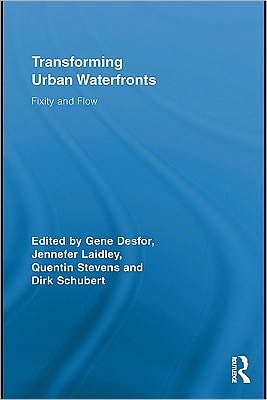
Transforming Urban Waterfronts: Fixity and Flow
0
0
As an Amazon Associate and affiliate partner, Menrva Books earns from qualifying purchases. Learn more
Author Description
In port cities around the world, waterfront development projects have been hailed both as spaces of promise and as crucial territorial wedges in twenty-first century competitive growth strategies. Frequently, these mega-projects have been intended to transform derelict docklands into communities of hope with sustainable urban economies—economies intended to both compete in and support globally-networked hierarchies of cities.This collection engages with major theoretical debates and empirical findings on the ways waterfronts transform and have been transformed in port-cities in North and South America, Europe, the Caribbean. It is organized around the themes of fixities (built environments, institutional and regulatory structures, and cultural practices) and flows (information, labor, capital, energy, and knowledge), which are key categories for understanding processes of change. By focusing on these fixities and flows, the contributors to this volume develop new insights for understanding both historical and current cases of change on urban waterfronts, those special areas of cities where land and water meet. As such, it will be a valuable resource for teaching faculty, students, and any audience interested in a broad scope of issues within the field of urban studies.
Menrva's Summary
THE THESIS
This volume investigates how urban waterfronts function as critical sites of economic competition and social transformation within the context of globalized city development. The authors, a team of international scholars in urban studies and planning, utilize a dual framework of 'fixities'—the built environment and institutional structures—and 'flows'—the movement of capital, labor, and information—to analyze the evolution of port cities. By examining diverse case studies across North America, South America, Europe, and the Caribbean, the text argues that these waterfronts are not merely static locations but dynamic zones where global economic strategies intersect with local urban realities.
THE SCOPE MAP
What You Will Find
- Comparative analysis of port city development across multiple continents including North and South America and Europe.
- A theoretical framework categorizing urban change into 'fixities' and 'flows'.
- Case studies examining the transition of derelict docklands into competitive urban economic hubs.
- Discussion on the intersection of regulatory structures, cultural practices, and global capital investment.
THE AUTHORITY PERSPECTIVE
Experts identify this collection as a significant contribution to urban studies, particularly for its structured approach to analyzing complex waterfront redevelopment projects. Readers frequently note the academic density of the prose, making it a primary resource for faculty and students engaged in urban planning and geography research.
Page Count:
352
Publication Date:
2010-01-01
Publisher:
Taylor & Francis Group
ISBN-10:
0203841298
ISBN-13:
9780203841297
Architecture
Economics
Geography
urban planning
Urban renewal
Sociology
Community Tags
Similar Books