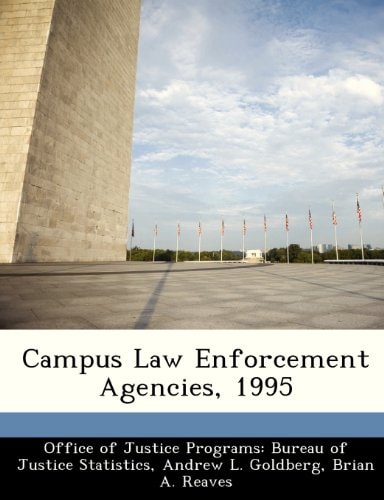
Campus Law Enforcement Agencies, 1995
0
0
As an Amazon Associate and affiliate partner, Menrva Books earns from qualifying purchases. Learn more
Author Description
This report, based on a new BJS survey, presents data collected from nearly 600 campus law enforcement agencies serving 4-year colleges and universities with 2,500 or more students. Three-fourths of these agencies used sworn police officers while the remainder relied on nonsworn security officers. Public campuses (93%) were more likely to have sworn officers than those under private control (43%); however, about three-fourths of the private universities with 10,000 or more students used sworn police. Sworn campus police officers typically had to pass through many more screening devices and undergo 3 to 4 times as much training as their nonsworn counterparts. Per student employment and expenditure for law enforcement at private institutions was nearly twice that of public campuses. Nearly all agencies operated general crime prevention programs on campus, and about two-thirds had programs aimed specifically at rape prevention. Other topics covered by the report include agency functions, personnel characteristics, equipment, computers and information systems, and policy directives. General campus characteristics, including crime statistics, are also summarized.
Menrva's Summary
THE THESIS
This report details the landscape of campus law enforcement agencies in 1995, drawing from a comprehensive survey of institutions serving 4-year colleges and universities with at least 2,500 students. The data reveals that three-fourths of these agencies employed sworn police officers, while the remainder utilized nonsworn security personnel. A significant disparity existed between public and private institutions regarding the use of sworn officers, with public campuses overwhelmingly favoring them. The report further examines the rigorous screening and training requirements for sworn officers compared to their nonsworn counterparts, as well as the differing per-student expenditures on law enforcement between public and private institutions.
THE SCOPE MAP
- Data collected from nearly 600 campus law enforcement agencies.
- Analysis of sworn police officers versus nonsworn security officers.
- Comparison of screening devices and training for sworn officers.
- Expenditure and employment data for law enforcement at public and private institutions.
- Overview of general crime prevention programs and specific rape prevention initiatives.
- Details on agency functions, personnel characteristics, and equipment.
- Information on computer and information systems used by agencies.
- Summary of policy directives, general campus characteristics, and crime statistics.
THE AUTHORITY PERSPECTIVE
This report, based on a 1995 BJS survey, provides a detailed statistical overview of campus law enforcement agencies. It highlights key differences in agency composition, personnel qualifications, and resource allocation between public and private institutions. The findings offer insights into the operational aspects of campus security and crime prevention efforts during that period. The data presented serves as a valuable resource for understanding the state of higher education security at the time.
Page Count:
54
Publication Date:
2012-09-20
Publisher:
BiblioGov
ISBN-10:
1249452961
ISBN-13:
9781249452966
Non-Fiction
History
Higher Education
Law Enforcement
Statistics
Community Tags
Similar Books