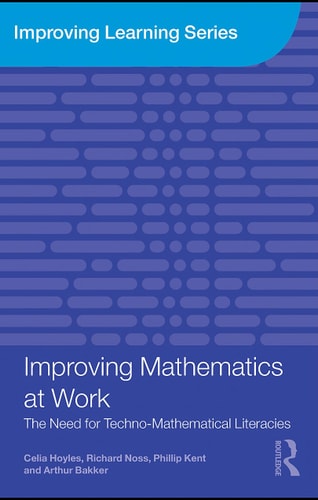
Improving Mathematics at Work: The Need for Techno-mathematical Literacies
0
0
As an Amazon Associate and affiliate partner, Menrva Books earns from qualifying purchases. Learn more
Author Description
Improving Mathematics at Work questions the mathematical knowledge and skills that matter in the twenty-first century world of work, and studies how the use of mathematics in the workplace is evolving in the rapidly-changing context of new technologies and globalisation. Through a series of case studies from the manufacturing and financial service sectors, the authors argue that there has been a radical shift in the type mathematical skills required for work – a shift not yet fully recognised by the formal education system, or by employers and managers.Examining how information technology has changed mathematical requirements, the idea of Techno-mathematical Literacies (TmL) is introduced to describe the emerging need to be fluent in the language of mathematical inputs and outputs to technologies and to interpret and communicate with these, rather than merely to be procedurally competent with calculations. The authors argue for careful analyses of workplace activities, looking beyond the conventional thinking about numeracy, which still dominates policy arguments about workplace mathematics. Throughout their study, the authors answer the following fundamental questions:
Menrva's Summary
THE THESIS
This book investigates the widening gap between traditional mathematical education and the evolving quantitative requirements of the modern, technology-driven workplace. Celia Hoyles and her co-authors utilize extensive field research to argue that the contemporary professional environment demands a new form of fluency termed Techno-mathematical Literacies (TmL). The authors contend that current educational frameworks and corporate training programs fail to address the shift from manual calculation to the interpretation of complex, technology-mediated data outputs.
THE SCOPE MAP
What You Will Find
- Comparative analysis of mathematical requirements in manufacturing and financial service sectors.
- The conceptual framework of Techno-mathematical Literacies (TmL) as a professional competency.
- Case studies documenting the integration of information technology into daily workplace tasks.
- Critical evaluation of current numeracy policies in formal education and corporate management.
THE AUTHORITY PERSPECTIVE
Experts in mathematics education and workplace training recognize this work as a foundational text for understanding the intersection of digital literacy and quantitative skill. Readers frequently note the academic density of the prose, which provides a rigorous evidence base for policy reform in professional development.
Page Count:
208
Publication Date:
2010-01-01
Publisher:
Routledge
ISBN-10:
0203854659
ISBN-13:
9780203854655
Workplace literacy
Communication in mathematics
Professional Development
Education
Sociology
Mathematics
Workplace
Technology
Community Tags
Similar Books