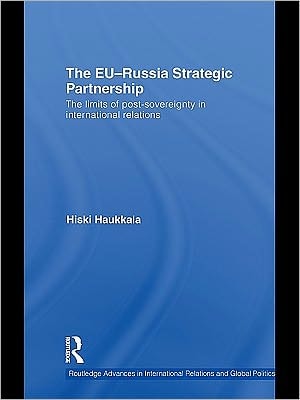
The EU-Russia Strategic Partnership: The Limits of Post-Sovereignty in International Relations
0
0
As an Amazon Associate and affiliate partner, Menrva Books earns from qualifying purchases. Learn more
Author Description
Machine Generated Contents Note: 1. Introduction -- 2. Theoretical Complementarity And Multi-causal Social Mechanisms In The Study Of International Relations -- 3. Theorizing Eu-russia Institutionalized Interaction -- 4. Multi-method Analysis In A Study Of International Institutionalization -- 5. Establishing The Baseline: Negotiating The Partnership And Cooperation Agreement, 1992-94 -- 6. Comparing The Strategy Documents -- 7. Second Chechen War -- 8. Four Common Spaces -- 9. Northern Dimension -- 10. Conclusions. Hiski Haukkala. Includes Bibliographical References And Index.
Menrva's Summary
THE THESIS
This book investigates the structural and political limitations of the strategic partnership between the European Union and Russia, questioning why institutionalized cooperation has consistently failed to achieve its intended goals. Hiski Haukkala, a scholar specializing in European foreign policy, utilizes a multi-causal social mechanism framework to analyze the interaction between these two powers. By examining key historical documents and specific geopolitical crises, the author argues that the EU's post-sovereign approach to international relations is fundamentally incompatible with Russia's traditional state-centric worldview. The study provides a rigorous academic assessment of the institutional frameworks that have governed EU-Russia relations since the early 1990s.
THE SCOPE MAP
What You Will Find
- Analysis of the Partnership and Cooperation Agreement (1992-1994) as a foundational baseline.
- Application of multi-method analysis to evaluate institutionalization in international relations.
- Case studies on the Second Chechen War, the Four Common Spaces, and the Northern Dimension.
- Theoretical exploration of the clash between post-sovereign EU norms and Russian sovereignty-focused policies.
THE AUTHORITY PERSPECTIVE
Experts in the field of European studies recognize this work as a significant contribution to understanding the structural friction between the EU and Russia. Readers frequently note the academic density of the prose, which is tailored for scholars and policy analysts interested in the mechanics of international institutionalization.
Page Count:
249
Publication Date:
2010-01-01
Publisher:
Routledge
ISBN-10:
0203856449
ISBN-13:
9780203856444
European Union
Diplomacy
International relations
Geopolitics
Community Tags
Similar Books