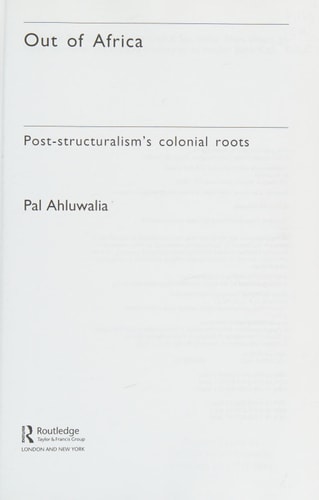
Out of Africa: post-structuralism's colonial roots
0
0
As an Amazon Associate and affiliate partner, Menrva Books earns from qualifying purchases. Learn more
Author Description
At the heart of this book is the argument that the fact that so many post-structuralist French intellectuals have a strong ‘colonial’ connection, usually with Algeria, cannot be a coincidence. The ‘biographical’ fact that so many French intellectuals were born in or otherwise connected with French Algeria has often been noted, but it has never been theorised. Ahluwalia makes a convincing case that post-structuralism in fact has colonial and postcolonial roots. This is an important argument, and one that ‘connects’ two theoretical currents that continue to be of great interest, post-structuralism and postcolonialism.The re-reading of what is now familiar material against the background of de-colonial struggles demonstrates the extent to which it is this new condition that prompted theory to question long-held assumptions inscribed in the European colonial enterprise. The wide-ranging discussion, ranging across authors as different as Foucault, Derrida, Fanon, Althusser, Cixous, Bourdieu and Lyotard, enables the reader to make connections that have remained unnoticed or been neglected. It also brings back into view a history of struggles, both political and theoretical, that has shaped the landscape of critique in the social sciences and humanities.This clear and lucid discussion of important and often difficult thinkers will be widely read and widely debated by students and academics alike.
Menrva's Summary
THE THESIS
This book investigates the extent to which the development of post-structuralist theory is inextricably linked to the colonial experiences of French intellectuals in Algeria. D. P. S. Ahluwalia, an expert in postcolonial studies, argues that the biographical connections between prominent French thinkers and the colonial enterprise are not coincidental but foundational to their theoretical output. By re-reading canonical texts through the lens of de-colonial struggles, the author posits that the shift in European intellectual thought was a direct response to the pressures and contradictions of the colonial condition.
THE SCOPE MAP
What You Will Find
- An analysis of the biographical links between French intellectuals and French Algeria.
- A theoretical framework connecting post-structuralism with postcolonial history.
- Comparative studies of key figures including Foucault, Derrida, Fanon, Althusser, Cixous, Bourdieu, and Lyotard.
- A historical examination of how de-colonial struggles shaped the landscape of modern social science critique.
THE AUTHORITY PERSPECTIVE
Scholars and students of critical theory frequently cite this work for its ability to bridge the gap between post-structuralist philosophy and postcolonial political history. The text is recognized for providing a clear and accessible entry point into the complex intellectual histories of some of the 20th century's most influential thinkers.
Page Count:
208
Publication Date:
2010-01-01
Publisher:
Routledge
ISBN-10:
0203858107
ISBN-13:
9780203858103
Philosophy
History
Social Science
Algeria
France
French
Structuralism
Community Tags
Similar Books