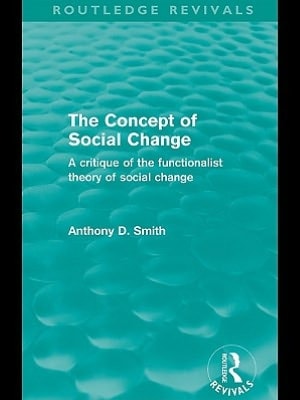
Concept of Social Change: A Critique of the Functionalist Theory of Social Change
0
0
As an Amazon Associate and affiliate partner, Menrva Books earns from qualifying purchases. Learn more
Author Description
Anthony Smith's important work on the concept of social change, first published in 1973, puts forward the paradigm of historical change as an alternative to the functionalist theory of evolutionary change. He shows that, in attempting to provide a theory of social change, functionalism reveals itself as a species of 'frozen' evolutionism.Functionalism, he argues, is unable to cope with the mechanisms of historical transitions or account for novelty and emergence; it confuses classification of variations with explanation of processes; and its endogenous view of change prevents it from coming to grips with the real events and transformations of the historical record. In his assessment of functionalism, Dr Smith traces its explanatory failures in its accounts of the developments of civilisation, modernisation and revolution. He concludes that the study of 'evolution' is largely irrelevant to the investigation of social change. He proposes instead an exogenous paradigm of social change, which places the study of contingent historical events at its centre.
Menrva's Summary
THE THESIS
This work investigates the fundamental limitations of functionalist theory in explaining the mechanisms of social change. Anthony D. Smith, a prominent scholar in the field of nationalism and social theory, evaluates the structural-functionalist paradigm that dominated mid-20th-century sociology. He argues that functionalism relies on an endogenous, evolutionary model that fails to account for historical contingency, novelty, and the actual processes of societal transformation. By critiquing these theoretical frameworks, Smith advocates for an exogenous paradigm that prioritizes the study of specific historical events and transitions over abstract evolutionary models.
THE SCOPE MAP
What You Will Find
- A critical analysis of functionalist theories of evolutionary change.
- An examination of the failures of functionalism in explaining modernization, civilization, and revolution.
- A proposed exogenous paradigm for analyzing social change based on historical contingency.
- A rigorous critique of the distinction between the classification of social variations and the explanation of social processes.
THE AUTHORITY PERSPECTIVE
Experts recognize this text as a significant intervention in the critique of structural-functionalism during the 1970s. Readers frequently note the academic density of the prose and its importance for students of historical sociology and social theory.
Page Count:
198
Publication Date:
2010-01-14
Publisher:
Taylor & Francis Group
ISBN-10:
0203851676
ISBN-13:
9780203851678
Philosophy
History
Social Theory
Social change
Academic
Sociology
Community Tags
Similar Books