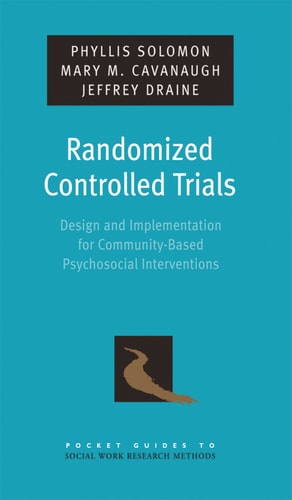
Randomized Controlled Trials: Design and Implementation for Community-Based Psychosocial Interventions
0
0
As an Amazon Associate and affiliate partner, Menrva Books earns from qualifying purchases. Learn more
Author Description
Randomized controlled trials (RCTs) are considered by many researchers and providers to be the gold standard of health and social service effectiveness research. However, there exist scant resources that deal with the complex nature of designing and implementing RCTs in community-based settings. This clearly written pocket guide provides researchers and social service practitioners insight into each step of an RCT. The goal of this text is to enable readers to understand, design, and implement a community-based RCT. From the initial stage of planning the RCT and developing its conceptual foundations through implementation, the authors provide a wealth of detail and case studies from social work practice research that assist readers to comprehend the detailed information provided. Accessible, concrete advice is woven throughout the text and tackles the many design and implementation challenges that arise in community practice settings. The importance of utilizing a mix of qualitative and quantitative methods is encouraged due to the intricate nature of RCT research in community-based environments. Through utilizing practical case examples, this pocket guide reviews the essentials of RCTs in a manner that will appeal to researchers, practitioners and students alike who are seeking the necessary tools to build the empirical knowledge base for community-based psychosocial interventions for social work.
Menrva's Summary
THE THESIS
This text investigates the methodological requirements and practical challenges of designing and implementing randomized controlled trials (RCTs) within complex community-based psychosocial settings. The authors, Jeffrey Draine, Mary M. Cavanaugh, and Phyllis Solomon, utilize their expertise in social work research to provide a structured framework for practitioners. They argue that while RCTs serve as a gold standard for effectiveness, their application in real-world community environments requires specific adaptations and a synthesis of both qualitative and quantitative data collection methods.
THE SCOPE MAP
What You Will Find
- Step-by-step guidance on the lifecycle of an RCT from conceptualization to implementation
- Methodological strategies for managing community-based research constraints
- Integration of qualitative and quantitative research techniques
- Practical case studies derived from social work practice
Scope Limits
- Does not cover advanced statistical analysis software or complex mathematical modeling
- Focuses specifically on psychosocial interventions rather than clinical medical trials
THE AUTHORITY PERSPECTIVE
Experts and students in the field of social work identify this guide as a practical, accessible resource for bridging the gap between theoretical research design and community practice. Readers frequently note that the inclusion of concrete case studies makes the dense methodological content manageable for those new to clinical research.
Page Count:
222
Publication Date:
2009-01-01
Publisher:
Oxford University Press
ISBN-10:
0190450444
ISBN-13:
9780190450441
Academic
Social Work
Social service
Research Methods
Psychosocial Interventions
Introduction to Social WorkWelfare
Public Health
Reference
Community Tags
Other Editions(2)
Similar Books