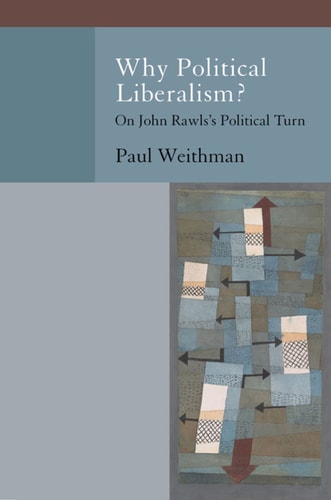
Why Political Liberalism?: On John Rawls's Political Turn
0
0
As an Amazon Associate and affiliate partner, Menrva Books earns from qualifying purchases. Learn more
Author Description
In Why Political Liberalism?, Paul Weithman offers a fresh, rigorous, and compelling interpretation of John Rawls's reasons for taking his so-called "political turn". Weithman takes Rawls at his word that justice as fairness was recast as a form of political liberalism because of an inconsistency Rawls found in his early treatment of social stability. He argues that the inconsistency is best seen by identifying the threats to stability with which the early Rawls was concerned. One of those threats, often overlooked by Rawls's readers, is the threat that the justice of a well-ordered society would be undermined by a generalized prisoner's dilemma. Showing how the Rawls of "A Theory of Justice" tried to avert that threat shows that the much-neglected third part of that book is of considerably greater philosophical interest, and has considerably more unity of focus, than is generally appreciated. Weithman painstakingly reconstructs Rawls's attempts to show that a just society would be stable, and just as carefully shows why Rawls came to think those arguments were inconsistent with other parts of his theory. Weithman then shows that the changes Rawls introduced into his view between "Theory of Justice" and "Political Liberalism" result from his attempt to remove the inconsistency and show that the hazard of the generalized prisoner's dilemma can be averted after all. Recovering Rawls's two treatments of stability helps to answer contested questions about the role of the original position and the foundations of justice as fairness. The result is a powerful and unified reading of Rawls's work that explains his political turn and shows his enduring engagement with some of the deepest concerns of human life.
Menrva's Summary
THE THESIS
This book investigates the philosophical motivations behind John Rawls's transition from the framework of 'A Theory of Justice' to the revised structure of 'Political Liberalism'. Paul Weithman, a scholar of political philosophy, utilizes a rigorous textual analysis of Rawls's primary works to argue that the 'political turn' was a deliberate attempt to resolve an internal inconsistency regarding social stability. By identifying the 'generalized prisoner's dilemma' as a central, overlooked threat to stability in Rawls's early work, Weithman provides a unified interpretation of how Rawls sought to refine his theory of justice.
THE SCOPE MAP
What You Will Find
- A detailed reconstruction of the stability arguments in 'A Theory of Justice'.
- An analysis of the 'generalized prisoner's dilemma' as a threat to social order.
- A comparative study of the evolution of Rawls's political thought.
Scope Limits
- The text does not provide a general biography of John Rawls.
- The analysis is restricted to the specific philosophical transition between the two named major works.
THE AUTHORITY PERSPECTIVE
Experts in political philosophy recognize this work as a significant contribution to the secondary literature on John Rawls. Readers frequently note the academic density of the prose, which is intended for scholars and advanced students of political theory.
Page Count:
393
Publication Date:
2011-01-01
Publisher:
Oxford University Press
ISBN-10:
0190453036
ISBN-13:
9780190453039
Philosophy
Ethics
Political Theory
Liberalism
Political Philosophy
Community Tags
Similar Books