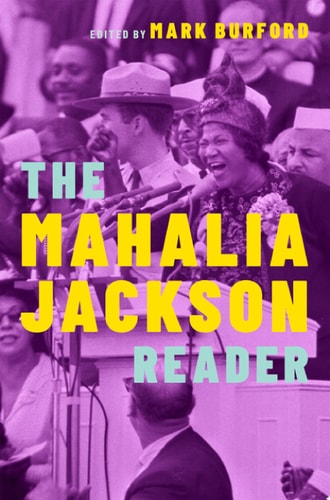
The Mahalia Jackson Reader
0
0
As an Amazon Associate and affiliate partner, Menrva Books earns from qualifying purchases. Learn more
Author Description
Born in New Orleans before migrating to Chicago, Mahalia Jackson (1911-72) is undoubtedly the most widely known black gospel singer, having achieved fame among African American communities in the 1940s then finding a wide audience among non-black U.S. and international audiences after she signed with major label Columbia Records in 1954. The newest entry in OUP's celebrated Readers on American Musicians series, The Mahalia Jackson Reader places Jackson's musical performances and their reception against key changes in 20th-century America, changes that include transformations of the recorded music industry, the increasing visibility of the civil rights movement, a florescence of Cold War-era religiosity, and an explosion of popularity of black gospel music itself. Jackson's career combines parallel tracks as a black church singer and as a national pop celebrity, and makes her one of the most complex and important black artists of the postwar decades.Gospel is a particularly challenging genre to study because of the paucity of sources. Because of Jackson's celebrity, there is more substantial coverage of her life and work than other gospel artists, but Jackson scholarship is still largely dependent on trade biographies from the 1970s for source material. For this reader, Mark Burford has gone beyond the standard biographies and has drawn from extensive archival research, including in the volume interview transcripts and the largely-untouched papers of Jackson's associate Bill Russell, who kept a journal tracking Jackson's activities from 1951 to 1955. The new sources - in particular Russell's notes - uniquely enable an assessment of the reciprocal relationship between the two careers Jackson pursued, essentially simultaneously: as an in-demand church singer in Chicago, and as a media star for a major network and recording label.
Menrva's Summary
THE THESIS
This volume investigates the dual trajectory of Mahalia Jackson’s career as both a foundational gospel singer and a mainstream pop celebrity within the context of 20th-century American cultural shifts. Author Mark Burford, a scholar of American music, utilizes archival research and previously unpublished primary sources to challenge the reliance on older, limited trade biographies. The work argues that Jackson’s career serves as a critical lens through which to view the intersection of the civil rights movement, the evolution of the recording industry, and the rise of Cold War-era religiosity.
THE SCOPE MAP
What You Will Find
- Archival documentation including interview transcripts and the personal journals of Bill Russell.
- Analysis of Jackson’s professional activities between 1951 and 1955.
- Examination of the reciprocal relationship between her church-based ministry and her commercial media presence.
Scope Limits
- The text focuses primarily on the mid-20th century, with less emphasis on her early life in New Orleans or her final years.
- The analysis is constrained by the available archival records, which are more robust for the 1950s than other periods.
THE AUTHORITY PERSPECTIVE
Experts highlight this volume as a significant contribution to gospel music scholarship due to its reliance on previously untouched archival materials. Readers frequently note that the book provides a necessary academic rigor that moves beyond the anecdotal nature of earlier Jackson biographies.
Page Count:
472
Publication Date:
2020-03-20
Publisher:
Oxford University Press
ISBN-10:
0190461659
ISBN-13:
9780190461652
History
Biography
Music
African American
Gospel Music
United States
African Americans
Singers
Community Tags
Other Editions(3)
Similar Books








Reader Comments
Share Your Thoughts
No comments yet. Be the first to share your thoughts!