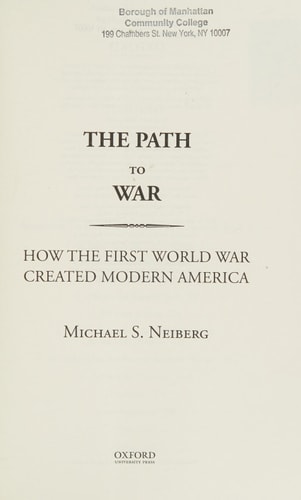
The Path to War: How the First World War Created Modern America
0
0
As an Amazon Associate and affiliate partner, Menrva Books earns from qualifying purchases. Learn more
Author Description
When war broke out in Europe in August of 1914, it seemed, to observers in the United States, the height of madness. The Old World and its empires were tearing each other apart, and while most Americans blamed the Germans, pitied the Belgians, and felt kinship with the Allies, they wanted no part in the carnage. Two years into war President Woodrow Wilson won re-election by pledging to keep out of the conflict. Yet by the spring of 1917-by which point millions had been killed for little apparent gain or purpose-the fervor to head "Over There" swept the country. America wanted in.The Path to War shows us how that happened. Entry into the war resulted from lengthy debate and soul-searching about national identity, as so-called "hyphenated citizens" of Irish and German heritage wrestled with what it meant to be American. Many hoped to keep to the moral high ground, condemning German aggression while withholding from the Allies active support, offering to mediate between the belligerents while keeping clear. Others, including the immensely popular former president Theodore Roosevelt, were convinced that war offered the country the only way to assume its rightful place in world affairs. Neiberg follows American reaction to such events as the sinking of the Lusitania, German terrorism, and the incriminating Zimmermann telegram, shedding light on the dilemmas and crises the country faced as it moved from ambivalence to belligerence.As we approach the centenary of the war, the effects of the pivot from peace to war still resonate, as Michael Neiberg's compelling book makes clear. The war transformed the United States into a financial powerhouse and global player, despite the reassertion of isolationism in the years that followed. Examining the social, political, and financial forces at work as well as the role of public opinion and popular culture, The Path to War offers both a compelling narrative and the inescapable conclusion that World War One was no parenthetical excep
Menrva's Summary
THE THESIS
How did the United States transition from a position of strict neutrality in 1914 to active belligerence in 1917? Michael S. Neiberg, a professor of history at the U.S. Army War College, examines the complex social, political, and cultural shifts that redefined American national identity during the early years of the First World War. He argues that the decision to enter the conflict was not a sudden reaction to a single event, but the culmination of a protracted internal debate regarding America's role on the global stage.
THE SCOPE MAP
What You Will Find
- Analysis of the influence of immigrant populations, specifically Irish and German Americans, on domestic policy.
- Examination of key catalysts including the sinking of the Lusitania and the Zimmermann telegram.
- Evaluation of the shift in American financial and geopolitical status during the war years.
Scope Limits
- The text focuses primarily on the American domestic experience and political decision-making rather than detailed battlefield tactics or European military strategy.
THE AUTHORITY PERSPECTIVE
Historians and reviewers frequently cite this work as a clear, accessible account of the American path to intervention. Experts highlight the book's ability to synthesize complex social pressures with high-level political maneuvering, making it a standard reference for understanding the domestic impact of the Great War.
Page Count:
320
Publication Date:
2016-10-03
Publisher:
Oxford University Press
ISBN-10:
0190464968
ISBN-13:
9780190464967
History
World War
Military History
United States
Political History
Community Tags
Similar Books