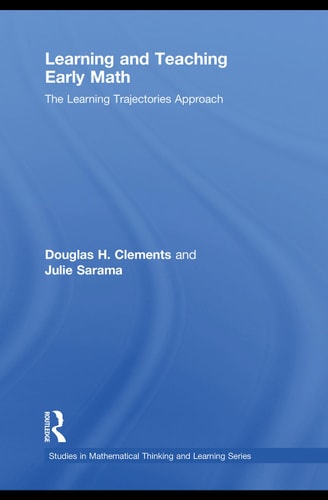
Learning and Teaching Early Math: The Learning Trajectories Approach
0
0
As an Amazon Associate and affiliate partner, Menrva Books earns from qualifying purchases. Learn more
Author Description
Preface 1. Young Children And Mathematics Learning 2. Quantity, Number, And Subitizing 3. Verbal And Object Counting 4. Comparing, Ordering, And Estimating 5. Arithmetic: Early Addition And Subtraction And Counting Strategies 6. Arithmetic: Composition Of Number, Place Value, And Multidigit Addition And Subtraction 7. Spatial Thinking 8. Shape 9. Composition And Decomposition Of Shapes 10. Geometric Measurement -- Length 11. Geometric Measurement, Part 2: Area, Volume, And Angle 12. Other Content Domains 13. Mathematical Processes 14. Cognition, Affect, And Equity 15. Early Childhood Mathematics Education: Contexts And Curricula 16. Instructional Practices And Pedagogical Issues. Douglas H. Clements And Julie Sarama. Includes Bibliographical References (p. 295-316) And Index.
Menrva's Summary
THE THESIS
This text investigates how the implementation of learning trajectories can optimize the development of mathematical proficiency in young children. Douglas H. Clements and Julie Sarama draw upon extensive research in cognitive development and classroom practice to propose a structured framework for early childhood mathematics. The authors argue that by understanding the specific paths children take to acquire mathematical concepts, educators can design more effective instructional interventions that align with developmental milestones.
THE SCOPE MAP
What You Will Find
- Detailed learning trajectories for core mathematical domains including counting, arithmetic, and geometry.
- Pedagogical strategies for teaching composition and decomposition of shapes.
- Analysis of cognitive, affective, and equity-based factors in early math learning.
- Evidence-based instructional practices for classroom curricula.
THE AUTHORITY PERSPECTIVE
Educators and researchers frequently cite this work as a foundational text for understanding the intersection of cognitive science and early childhood mathematics instruction. The prose is noted for its academic rigor and its practical utility in designing classroom-based learning experiences.
Page Count:
327
Publication Date:
2009-01-01
Publisher:
Routledge
ISBN-10:
0203883381
ISBN-13:
9780203883389
Pedagogy
Mathematics
Teaching Methods
Education
Community Tags
Similar Books