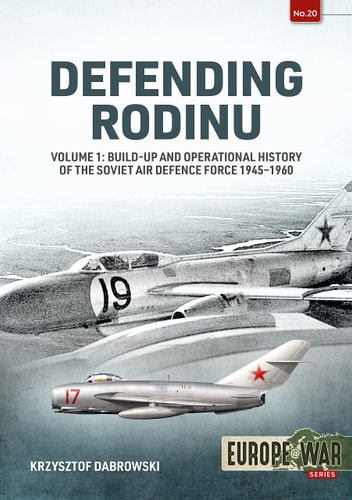
Defending Rodinu: Development and Operational History of the Soviet Air Defence Force, 1961-1991
0
0
As an Amazon Associate and affiliate partner, Menrva Books earns from qualifying purchases. Learn more
Author Description
When the Second World War ended in 1945 the Soviets had numerous conventional anti-aircraft guns and piston engine fighters in service but with the rapid advances of aviation technology much of this was facing obsolescence. Worse, the war-ravaged country was facing new challenges as the end of the war did not bring a time of universal peace but instead a new rivalry with the West in a Cold War, which could at any time turn hot both figuratively and literally. Western competitors for world domination, primarily the United States, could boast a huge bomber fleet capable of delivering devastating nuclear strikes. Developing and fielding technologically and qualitatively new ground-based defenses and fighter aircraft became a most urgent imperative and in a relatively short time remarkable progress was achieved in these fields. Guided surface-to-air missiles were developed and fielded, and jet powered fighters entered service, their performance ever improving from high-subsonic to supersonic speeds. Similar advances were made in the fields of air-to air armaments and detection and early warning technology. While nuclear-armed Western bombers never appeared in the skies over the Soviet Union numerous foreign reconnaissance aircraft did. Thus, the Soviet air defense arsenal was tested many times in actual combat against actual and perceived violators of their airspace and other challengers, in which the Soviet air defenses experienced both embarrassing defeats and exhilarating victories. Relegated to dusty files, the story of Soviet air defenses in arguably the hottest period of direct US-Soviet Cold War confrontation. Volume 1 of Defending Rodinu examines the development of the Soviet air defense forces from the immediate aftermath of the Second World War up until 1960. It looks at the development of dedicated interceptor aircraft, surface-to-air missiles and the radar network needed to support these, along with a detailed history of the attempts, succe
Menrva's Summary
THE THESIS
The Soviet Union faced an existential threat from Western air power at the dawn of the Cold War, necessitating a rapid and radical transformation of its air defense capabilities. Following World War II, Soviet air defenses were largely obsolete, but the escalating rivalry with the United States, which possessed a formidable bomber fleet capable of delivering nuclear strikes, made developing advanced interceptors, surface-to-air missiles (SAMs), and sophisticated radar networks a paramount urgency. This period saw significant technological leaps, with jet fighters replacing piston engines and SAMs entering service, while air-to-air armaments and early warning systems also saw substantial improvements. The Soviet air defense forces were repeatedly tested against reconnaissance aircraft and other perceived airspace violators, experiencing both notable successes and critical failures in their mission to protect Soviet territory.
THE SCOPE MAP
- Development of dedicated interceptor aircraft from the post-WWII era through 1960.
- The evolution and deployment of surface-to-air missile systems.
- The establishment and expansion of the Soviet radar network for detection and early warning.
- Analysis of key operational engagements and their outcomes.
- The technological advancements in air-to-air armaments.
- The strategic context of the Cold War and its impact on Soviet air defense doctrine.
THE AUTHORITY PERSPECTIVE
This volume appears to offer a detailed historical account of the Soviet Air Defence Force's formative years, focusing on the critical period between the end of World War II and 1960. The subject matter suggests a deep dive into military technological development and operational history, likely appealing to specialists in Cold War aviation and Soviet military studies. The author's background in military aviation writing indicates a focus on technical accuracy and historical context. The scope, as outlined, covers the foundational elements of interceptor aircraft, SAMs, and radar, setting the stage for subsequent developments.
Page Count:
66
Publication Date:
2023-01-01
Publisher:
Helion
ISBN-10:
1915070716
ISBN-13:
9781915070715
History
Non-Fiction
Aviation
Military History
Soviet Union
Aviation History
Aerospace
Community Tags
Similar Books








Reader Comments
Share Your Thoughts
No comments yet. Be the first to share your thoughts!