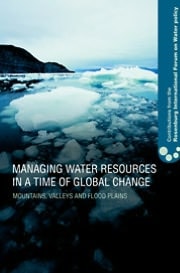
Managing Water Resources in a Time of Global Change: Mountains, Valleys and Flood Plains
0
0
As an Amazon Associate and affiliate partner, Menrva Books earns from qualifying purchases. Learn more
Author Description
Global change possesses serious challenges for water managers and scientists. In mountain areas, where water supplies for half of the world population originate, climate and hydrologic models are still subject to considerable uncertainty. And yet, critical decisions have to be taken to ensure adequate and safe water supplies to billions of people, millions of farmers and industries, without further deteriorating rivers and water bodies. While global warming is known to cause glaciers' retreat and reduced snow packs around the world, it is not clear that mountain discharge will be lower. What is widely recognised is that water management must be adapted to accommodate significant regime changes. However, this inevitably involves managing transboundary rivers, adding further complexity to putting principles in practice.This book takes global warming and the importance of mountain areas in world water resources as the starting point. First, it provides detailed reviews of the processes going on in several rivers systems and world regions in Europe (Rhône and Ebro), North America (Canadian Rockies, Western US and Mexico), the Middle East (Jordan), Africa (Tunisia, Kenya and South Africa). These contexts provide case studies and examples that show the difficulties and potential for adaptation to global change. Land-use, economics, numerous modeling approaches are some of the cross-cutting issues covered in the chapters. The volume also includes the views of water practitioners, with two chapters authored by members of the US-Canada International Joint Commission, an industrialist from Western Canada and an environmental leader in Spain.By combining a rich set of contexts and approaches, the volume succeeds in offering a view of the global challenges faced by water agencies, international donors and researchers around the world. A case is made in some chapters to seek adaptive strategies rather than trying to reduce or control resources variability. This requires factorin
Menrva's Summary
THE THESIS
This book investigates how water management systems must adapt to the hydrologic uncertainties and regime changes caused by global warming, particularly in mountain-fed river basins. Alberto Garrido, an expert in water economics and policy, compiles research from hydrologists, economists, and practitioners to address the tension between increasing water demand and the physical instability of mountain water sources. The text argues that rather than attempting to control resource variability, agencies should prioritize the development of flexible, adaptive strategies that account for both ecological health and human consumption needs.
THE SCOPE MAP
What You Will Find
- Comparative analysis of river systems in Europe, North America, the Middle East, and Africa.
- Integration of climate modeling, land-use economics, and hydrologic forecasting.
- Case studies featuring the Rhône, Ebro, Canadian Rockies, and Jordan river basins.
- Perspectives from water practitioners, including members of the US-Canada International Joint Commission and industrial stakeholders.
THE AUTHORITY PERSPECTIVE
Experts recognize this volume as a comprehensive resource for understanding the intersection of climate science and water governance. Readers frequently note the technical density of the case studies, which provide a practical framework for professionals and researchers in the field of resource management.
Page Count:
272
Publication Date:
2008-01-01
Publisher:
Routledge
ISBN-10:
0203884388
ISBN-13:
9780203884386
Science
Public Policy
Environment
Climate Change
Hydrology
Community Tags
Similar Books