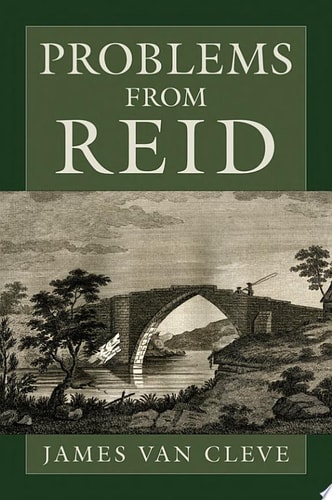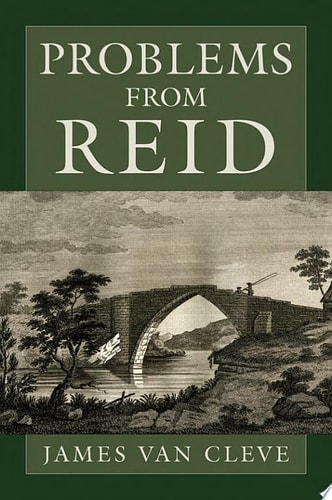
Problems from Reid
0
0
As an Amazon Associate and affiliate partner, Menrva Books earns from qualifying purchases. Learn more
Author Description
James Van Cleve here shows why Thomas Reid (1710-96) deserves a place alongside the other canonical figures of modern philosophy. He expounds Reid's positions and arguments on a wide range of topics, taking interpretive stands on points where his meaning is disputed and assessing the value of his contributions to issues philosophers are discussing today.Among the topics Van Cleve explores are Reid's account of perception and its relation to sensation, conception, and belief; his nativist account of the origin of the concepts of space and power; his attempt to clear the way for the belief that the things we directly perceive are external things, not ideas in our minds; his stand on the distinction between primary and secondary qualities; his account of "acquired perception," whereby we come to stand in a quasi-perceptual relation to qualities not originally perceived; his claim that visual space is non-Euclidean; his answers to the questions why we see the world right side up with inverted retinal images and whether a newly sighted person would recognize by sight the shapes he previously knew by touch; whether memory, like perception, is a form of direct awareness; and how we manage to conceive of things that are utterly nonexistent. Also examined are Reid's account of human knowledge by means of "first principles," his externalist reply to philosophical skepticism, his volitional theory of action, his use of the distinction between event causation and agent causation to understand freedom of the will, and his criticism of Hume and anticipation of Moore on the analysis of moral judgment.The most comprehensive work on Reid in a quarter century, this book will be welcomed by students of early modern philosophy, epistemology, the philosophy of perception, and the philosophy of action.
Menrva's Summary
THE THESIS
This work investigates the philosophical contributions of Thomas Reid to determine his standing among canonical modern philosophers and the relevance of his arguments to contemporary discourse. James Van Cleve, a scholar of early modern philosophy, provides a rigorous analysis of Reid's positions on perception, epistemology, and action theory. By examining disputed interpretations of Reid's texts, the author assesses the validity of his claims regarding human knowledge, skepticism, and the nature of reality. The book serves as a systematic reconstruction of Reid's philosophical framework, contrasting his views with those of his contemporaries and successors.
THE SCOPE MAP
What You Will Find
- Analysis of Reid's theories on perception, sensation, and the distinction between primary and secondary qualities.
- Examination of Reid's externalist response to philosophical skepticism and his reliance on first principles.
- Discussion of agent causation versus event causation in the context of free will.
- Exploration of Reid's anticipation of later moral philosophy and his critique of Hume.
Scope Limits
- The text focuses primarily on Reid's technical philosophical arguments rather than a biographical account of his life.
- It does not provide an exhaustive history of the Scottish Enlightenment beyond its direct relevance to Reid's specific arguments.
THE AUTHORITY PERSPECTIVE
Experts recognize this volume as a comprehensive and authoritative resource for students and scholars of early modern philosophy. Readers frequently note the technical density of the prose, which is tailored for those already familiar with the foundational debates in epistemology and the philosophy of perception.
Page Count:
567
Publication Date:
2015-01-01
Publisher:
Oxford University Press
ISBN-10:
0190463554
ISBN-13:
9780190463557
Philosophy
Philosophy history
Metaphysics
Ethics
History & Surveys
Epistemology