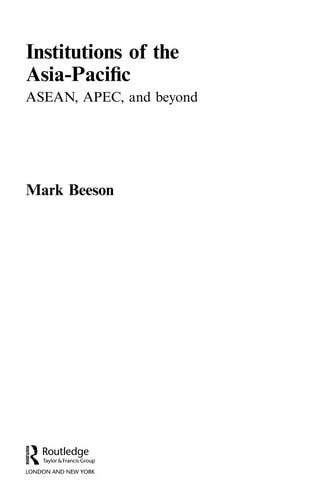
Institutions of the Asia-Pacific: ASEAN, APEC and Beyond
0
0
As an Amazon Associate and affiliate partner, Menrva Books earns from qualifying purchases. Learn more
Author Description
The Asia-Pacific is arguably the most important, but also the most complex and contested, region on the planet. Containing three of the world's largest economies and some of its most important strategic relationships, the region's capacity of regional elites to promote continuing economic development whilst simultaneously maintaining peace and stability will be one of the defining challenges of the twenty-first century international order.Intuitively, we might expect regional institutions to play a major role in achieving this. Yet one of the most widely noted characteristics of the Asia-Pacific region has been its relatively modest levels of institutional development thus far. However, things are changing: as individual economies in the Asia-Pacific become more deeply integrated, there is a growing interest in developing and adding to the institutions that already exist.Institutions of the Asia-Pacific examines how this region is developing, and what role established organisations like APEC and new bodies like ASEAN Plus Three are playing in this process. An expert in the field, Mark Beeson introduces the contested nature of the very region itself - should it be the 'Asia-Pacific' or 'East Asia' to which we pay most attention and expect to see most institutional development. By placing these developments in historical context, he reveals why the very definition of the region remains unsettled and why the political, economic and strategic relations of this remarkably diverse region remain fraught and difficult to manage.
Menrva's Summary
THE THESIS
This book investigates why the Asia-Pacific region has historically maintained modest levels of institutional development despite its status as a critical hub for global economic and strategic power. Mark Beeson, a recognized expert in international relations, utilizes a historical and political framework to analyze the complexities of regional integration. He argues that the contested definitions of the region itself—whether focused on the 'Asia-Pacific' or 'East Asia'—directly influence the efficacy and formation of governing bodies like APEC and ASEAN Plus Three.
THE SCOPE MAP
What You Will Find
- Historical analysis of regional integration efforts in the Asia-Pacific.
- Comparative study of established organizations such as APEC and emerging bodies like ASEAN Plus Three.
- Examination of the political and strategic tensions that complicate regional cooperation.
- Evaluation of the capacity of regional elites to balance economic development with long-term stability.
THE AUTHORITY PERSPECTIVE
Experts in international relations identify this work as a foundational text for understanding the structural challenges of regional governance in Asia. Readers frequently note the clarity with which Beeson navigates the dense political landscape of the region, making it an accessible resource for both students and policy analysts.
Page Count:
131
Publication Date:
2009-01-01
Publisher:
Routledge
ISBN-10:
0203893212
ISBN-13:
9780203893210
Economics
ASEAN
Geopolitics
International relations
Regionalism
Community Tags
Similar Books