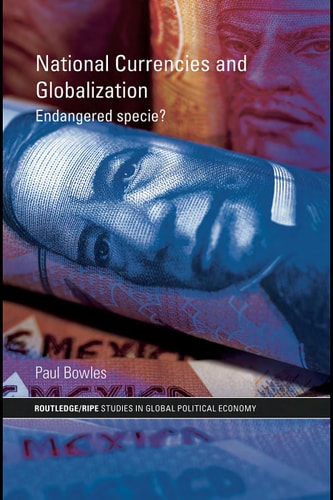
National Currencies and Globalization: Endangered Species?
0
0
As an Amazon Associate and affiliate partner, Menrva Books earns from qualifying purchases. Learn more
Author Description
Globalization and money – two concepts inextricably linked. In many ways the speed with which financial resources traverse the globe, the opportunities which this provides for the efficient allocation of resources, the possibilities which this creates for financial crises and traders who act as agents removed from the concerns of national citizens have come to symbolize the phenomenon, hopes and fears of ‘globalization’. However, inextricably linked they may be, but well understood they are not. In the case of national currencies, a wide variety of predictions and analyses can be found. For some, national currencies represent barriers to a seamless global economy. Others argue that national currencies will disappear due to the power of international financial markets which will force national governments to adopt more credible currencies and abandon their own. In contrast, others see imperialism or regionalism as the main challenges. Paul Bowles provides an innovative and systematic analysis of the implications of theories of globalization for national currencies. He critically examines whether, as a result, the world is heading for fewer currencies. He argues that the main ‘force of globalization’ which is endangering national currencies is that of globalization as ‘neoliberal globalism’. However there is no single neoliberal position on money and so the ‘contingent’ nature of neoliberalism explains why this particular force of globalization operates more strongly in some countries than others. This is demonstrated in case studies of four systemically significant currencies, namely, those of Australia, Canada, Mexico and Norway. National Currencies and Globalization will be of interest to researchers and students of International Political Economy, Politics, Economics and Finance.
Menrva's Summary
THE THESIS
This book investigates whether the forces of globalization, specifically neoliberal globalism, are leading to the inevitable decline and disappearance of national currencies. Paul Bowles, a scholar in international political economy, utilizes a systematic analytical framework to challenge the assumption that a globalized economy necessitates a reduction in the number of world currencies. He argues that the impact of neoliberalism on monetary policy is contingent rather than uniform, resulting in varied outcomes across different sovereign states.
THE SCOPE MAP
What You Will Find
- An analysis of the theoretical intersection between globalization and national monetary sovereignty.
- A critical examination of neoliberal globalism as a primary driver of currency instability.
- Comparative case studies focusing on the currencies of Australia, Canada, Mexico, and Norway.
- An evaluation of how regionalism and international financial markets influence government monetary policy.
THE AUTHORITY PERSPECTIVE
Experts and researchers in international political economy identify this work as a significant contribution to understanding the nuances of monetary sovereignty in a globalized era. Readers frequently note the clarity with which the author navigates complex economic theories while providing grounded, empirical evidence through his selected case studies.
Page Count:
0
Publication Date:
2008-01-01
Publisher:
Routledge
ISBN-10:
0203933370
ISBN-13:
9780203933374
Economics
Finance
International relations
Globalization
Money
Neoliberalism
Community Tags
Similar Books