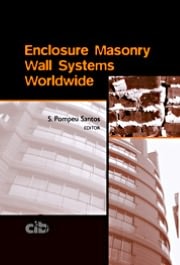
Enclosure Masonry Wall Systems Worldwide
0
0
As an Amazon Associate and affiliate partner, Menrva Books earns from qualifying purchases. Learn more
Author Description
Enclosure walls have a key role in building construction, providing structural safety and protecting interiors from intrusion. The concept of an enclosure wall is a traditional one, common to the building history of many countries. There is a tremendous variety in types of enclosure walls, depending on such variables as climate and local technologies. Progress in these traditional practices has been stimulated by new national and international standards in the construction industry. These standards have contributed to improvements in areas such as thermal insulation and earthquake resistance and have promoted the development of new materials and methods in enclosure wall construction. The aim of this book, by the Commission on Wall Structures of the International Council for Building (CIB), is to select certain countries or regions, and examine enclosure masonry walls which are perceived as being typical. For each example, the following are considered: characterization of the building sector; the customary materials used in masonry; typical problems and solutions for enclosure walls; and evolutionary trends.
Menrva's Summary
THE THESIS
This book investigates the diverse methodologies and regional adaptations of enclosure masonry wall systems within the context of evolving international construction standards. Edited by S. Pompeu Santos on behalf of the Commission on Wall Structures of the International Council for Building (CIB), the text synthesizes global practices to evaluate how traditional masonry techniques have integrated modern requirements for thermal efficiency and seismic safety. It provides a comparative analysis of how local climate and material availability influence the structural evolution of building envelopes across various countries.
THE SCOPE MAP
What You Will Find
- Comparative analysis of masonry enclosure systems across diverse international regions
- Technical evaluation of thermal insulation and earthquake resistance standards
- Documentation of customary materials and regional construction methodologies
- Examination of evolutionary trends in building envelope design and practice
THE AUTHORITY PERSPECTIVE
Experts recognize this volume as a foundational reference for understanding the intersection of traditional masonry practices and contemporary building codes. Professionals and students in the field of civil engineering frequently utilize the text for its systematic approach to regional construction analysis.
Page Count:
214
Publication Date:
2006-01-01
Publisher:
Taylor & Francis, Inc.
ISBN-10:
0203947037
ISBN-13:
9780203947036
Architecture
Building Technology
Construction
Masonry
Engineering
Community Tags
Similar Books