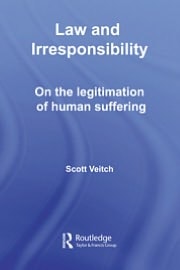
Law and Irresponsibility: On the Legitimation of Human Suffering
0
0
As an Amazon Associate and affiliate partner, Menrva Books earns from qualifying purchases. Learn more
Author Description
Law is widely assumed to provide contemporary society with its most important means of organizing responsibility. Across a broad range of areas of social life – from the activities of states and citizens, to work, business and private relationships – it is understood that legal regulation plays a crucial role in defining and limiting responsibilities. But Law and Irresponsibility pursues the opposite view: it explores how law organizes irresponsibility.With a particular focus on large-scale harms – including extensive human rights violations, forms of colonialism, and environmental or nuclear devastation – this book analyzes the ways in which law legitimates human suffering by demonstrating how legal institutions operate as much to deflect responsibility for harms suffered as to acknowledge them. Drawing on a series of case studies, it shows not only how law facilitates the dispersal and disavowal of responsibility, but how it does so in consistent and patterned ways.Irresponsibility is organized, and its organization is traced here to the legal forms, and the social and political conditions, that sustain ‘our’ complicity in human suffering.This innovative and interdisciplinary book provides a radical challenge to conventional thinking about law and legal institutions. It will be of considerable interest to those working in law, political and legal theory, sociology and moral philosophy.
Menrva's Summary
THE THESIS
This book investigates the paradox of how legal systems, typically viewed as mechanisms for accountability, function to organize and legitimate widespread irresponsibility and human suffering. Scott Veitch, a scholar of legal theory, challenges the conventional assumption that law serves primarily to assign responsibility. By examining the structural mechanics of legal institutions, he argues that these systems often operate to disperse, deflect, and disavow accountability for large-scale harms, thereby sustaining complicity in systemic suffering.
THE SCOPE MAP
What You Will Find
- Analysis of legal frameworks that facilitate the dispersal of responsibility for large-scale harms.
- Case studies covering human rights violations, colonialism, and environmental devastation.
- Examination of the social and political conditions that sustain complicity in human suffering.
- Interdisciplinary critique bridging legal theory, sociology, and moral philosophy.
THE AUTHORITY PERSPECTIVE
Scholars and students of legal theory recognize this work as a significant challenge to traditional jurisprudence regarding the role of law in society. Readers frequently note the dense, analytical nature of the prose, which is intended for an academic audience interested in the intersection of law and ethics.
Page Count:
168
Publication Date:
2007-01-01
Publisher:
Routledge Cavendish
ISBN-10:
0203940393
ISBN-13:
9780203940396
Philosophy
Responsibility
Political Theory
Human rights
Law and ethics
Law
Sociology
Community Tags
Similar Books