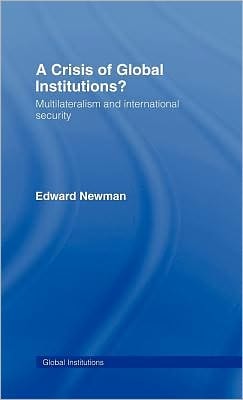
A Crisis Of Global Institutions?: Multilateralism And International Security
0
0
As an Amazon Associate and affiliate partner, Menrva Books earns from qualifying purchases. Learn more
Author Description
The Legitimacy Of Global Institutions Which Address Security Challenges Is In Question. The Manner In Which They Make Decisions And The Interests They Reflect Often Falls Short Of Twenty-first Century Expectations And Norms Of Good Governance. And Their Performance Has Raised Doubts About Their Ability To Address Contemporary Challenges Such As Civil Wars, Weapons Of Mass Destruction, Terrorism, And The Use Of Military Force In International Politics. This Book Explores The Sources Of This Challenge To Multilateralism - Including Us Pre-eminence, The Changing Nature Of International Security, And Normative Concerns About The Way Decisions Are Taken In International Organizations. It Argues That Whilst Some Such Challenges Are A Sign Of 'crisis', Many Others Are Representative Of 'normality' And Continuity In International Relations. Nevertheless, It Is Essential To Consider How Multilateralism Might Be More Viably Constituted To Cope With Contemporary And Future Demands. Addressing Topical Issues, Such As The War Against Iraq In 2003 And Terrorism, And Presenting Provocative Arguments, A Crisis In Global Institutions? Will Have Broad Appeal Amongst Specialist Readers Interested In International Relations, Security And International Organizations As Well As Students Generally. Multilateral Malaise: Sources And Manifestations -- The United States, Power, And Multilateralism -- Collective Security And The Use Of Force -- Humanitarian Intervention -- Weapons Of Mass Destruction -- Civil War, State Failure And Peacebuilding -- Terrorism -- Conclusion: Revisiting Institutionalism In A Post-westphalian World. Edward Newman. Series Numbered Retrospectively. Includes Bibliographical References (p. [156]-180) And Index.
Menrva's Summary
THE THESIS
This book investigates whether the perceived decline of multilateralism represents a genuine crisis of global institutions or a continuation of historical patterns in international relations. Edward Newman, an expert in international security and peacebuilding, utilizes a framework of institutional analysis to evaluate how global organizations manage contemporary threats. He examines the tension between traditional state-centric power dynamics and the evolving expectations for good governance in the twenty-first century. The text argues that while some institutional failures are acute, many reflect the inherent complexities of a post-Westphalian world order.
THE SCOPE MAP
What You Will Find
- Analysis of the impact of United States hegemony on multilateral decision-making processes.
- Examination of specific security challenges including humanitarian intervention, civil war, and state failure.
- Evaluation of institutional responses to terrorism and the proliferation of weapons of mass destruction.
- A critical review of the normative foundations and legitimacy of international organizations.
THE AUTHORITY PERSPECTIVE
Scholars and students of international relations frequently cite this work for its clear articulation of the challenges facing collective security frameworks. The text is recognized as a useful resource for understanding the structural limitations of international organizations in the early twenty-first century.
Page Count:
200
Publication Date:
2007-01-01
Publisher:
Routledge
ISBN-10:
0203947096
ISBN-13:
9780203947098
History
Security Studies
International relations
Community Tags
Similar Books