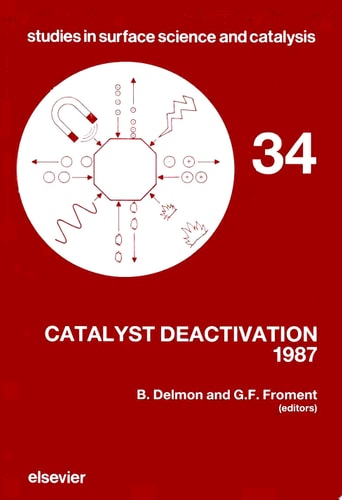
Catalyst Deactivation 1987
0
0
As an Amazon Associate and affiliate partner, Menrva Books earns from qualifying purchases. Learn more
Author Description
This Symposium on Catalyst Deactivation ensues those held at Berkeley (1985), Antwerp (1980) and Berkeley (1978).The three main topics emphasised at this most recent symposium were: the techniques used in deactivation studies, the mechanisms of catalyst deactivation, and modelling. With respect to the first, it became apparent that the study of deactivation faces even more difficulties than the characterization of fresh catalysts and the measurement of activity or selectivity, due to the multiplicity of interacting processes occurring during deactivation. Quite substantial progress has been made recently in the understanding of the mechanisms of various deactivation processes, particularly coking, and extra time was accorded to these topics at the symposium. The third topic corresponds to a problem which is very central to development studies and to the chemical engineering aspect of catalysis: it deals with the representativity of accelerated tests and the modelling of the deactivation phenomena.
Menrva's Summary
THE THESIS
The study of catalyst deactivation presents significant challenges due to the complex interplay of processes occurring during deactivation. This symposium, following previous gatherings in 1978, 1980, and 1985, emphasizes techniques for deactivation studies, the underlying mechanisms, and modeling approaches. While characterizing fresh catalysts and measuring activity are difficult, deactivation studies face even greater complexity. Substantial advancements have been made in understanding mechanisms, particularly coking, with dedicated sessions at the symposium. The modeling aspect addresses the crucial issues of accelerated test representativity and the simulation of deactivation phenomena, vital for development studies and chemical engineering.
THE SCOPE MAP
- Techniques used in deactivation studies
- Mechanisms of catalyst deactivation, with a focus on coking
- Modeling of deactivation phenomena
- Representativity of accelerated tests
- Challenges in characterizing deactivating catalysts compared to fresh catalysts
- Interacting processes occurring during deactivation
THE AUTHORITY PERSPECTIVE
This symposium volume likely serves as a comprehensive record of the state-of-the-art in catalyst deactivation research as of 1987. The emphasis on techniques, mechanisms, and modeling suggests a focus on both fundamental understanding and practical application within chemical engineering. The content would appeal to researchers and engineers involved in catalysis, process development, and materials science seeking to understand and mitigate catalyst degradation. The detailed discussion of challenges and recent progress indicates a valuable resource for those working with catalytic processes.
Page Count:
660
Publication Date:
1987-09-01
Publisher:
Elsevier
ISBN-10:
0080960685
ISBN-13:
9780080960685
Science
Non-Fiction
Chemical Engineering
Research
Symposium Proceedings
Catalysis
Community Tags
Similar Books