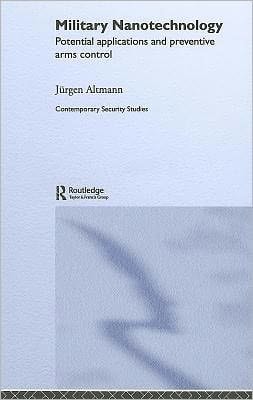
Military Nanotechnology: Potential Applications and Preventive Arms Control
0
0
As an Amazon Associate and affiliate partner, Menrva Books earns from qualifying purchases. Learn more
Author Description
With revolutionary changes in nanotechnology (NT) now on the horizon, many countries have started major research and development (R&D) programmes, which are mainly civilian. Often overlooked are military R&D programmes – in particular those of the US government. This is the first systematic and comprehensive presentation of the potential military applications of NT.In ten to twenty years, these applications may include extremely small computers, robots, missiles, satellites, launchers and sensors. They may also provide lighter and stronger materials for vehicles and weapons, implants in soldiers’ bodies, metal-free firearms, autonomous fighting systems, and smaller chemical and biological weapons.These potential uses raise strong concerns. This assessment is made from a viewpoint of international security, considering the new criteria of dangers for arms control and the international law of warfare, dangers for stability through potential new arms races and proliferation, and dangers for humans and society. Some military applications, such as computers, will be so close to civilian uses that limits are impractical. Others, such as sensors for biological-warfare agents, may contribute to stronger protection against terrorist attacks and better verification of compliance with arms-control treaties.For preventive limitation of these new technologies, specific approaches are proposed that balance positive civilian uses and take into account verification of compliance, with a view to international peace and security, not national military strength.This book will be of great interest to scholars of military technology, non-lethal weapons, disarmament and security studies in general.
Menrva's Summary
THE THESIS
This book investigates the potential military applications of nanotechnology and proposes frameworks for preventive arms control to mitigate risks to international security. Jürgen Altmann, a physicist and researcher specializing in security and peace studies, utilizes a systematic analysis of current research and development trends to evaluate how emerging nanoscale technologies could alter warfare. The text argues that while civilian applications are prominent, the unchecked military integration of these technologies poses significant dangers regarding proliferation, stability, and the international law of warfare.
THE SCOPE MAP
What You Will Find
- Analysis of potential military hardware including autonomous systems, miniaturized sensors, and advanced materials.
- Evaluation of the dual-use nature of nanotechnology and the difficulty of distinguishing between civilian and military research.
- Assessment of international security risks, including the potential for new arms races and the proliferation of chemical or biological weapons.
- Proposed policy approaches for preventive arms control that prioritize international stability over national military dominance.
THE AUTHORITY PERSPECTIVE
Experts in security studies and disarmament recognize this work as a foundational text for understanding the intersection of emerging technology and international law. Readers frequently note the technical rigor of the analysis and the author's balanced approach to the dual-use dilemma inherent in nanotechnology research.
Page Count:
256
Publication Date:
2007-01-01
Publisher:
Taylor & Francis Group
ISBN-10:
0203963792
ISBN-13:
9780203963791
Nanotechnology
International relations
Technology
Military Science
Security Studies
Arms Control
Community Tags
Similar Books