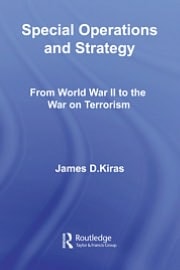
Special Operations and Strategy: From World War II to the War on Terrorism
0
0
As an Amazon Associate and affiliate partner, Menrva Books earns from qualifying purchases. Learn more
Author Description
Historically, Special Forces have been prone to misuse or misapplication. In particular, how special operations achieve their strategic effects has not been well understood. This stems in part from the Western historical tradition of the independently decisive 'great raid'. This work examines how a number of different special operations, in conjunction with more conventional military actions, achieve and sustain strategic effect(s) over time. In particular, this thesis argues that the root of effective special operations lies in understanding the relationship that exists between moral and material attrition at the strategic level through an examination of strategic theory and case studies. The key to understanding how special operations improve strategic performance resides in the concept of strategic attrition, and by extension, the nature of strategy. The nature of strategy reflects the complexities associated with moral and material interactions between competing adversaries.
Menrva's Summary
THE THESIS
This work investigates how special operations forces achieve strategic effects and why they have historically been prone to misuse or misapplication. James D. Kiras, a scholar of military strategy, utilizes a framework rooted in the theories of Carl von Clausewitz and Hans Delbrück to analyze the relationship between moral and material attrition. By examining the intersection of conventional military actions and specialized operations, the author argues that the effectiveness of these forces depends on a nuanced understanding of strategic performance rather than the myth of the independently decisive raid.
THE SCOPE MAP
What You Will Find
- Analysis of strategic attrition as a core concept for evaluating military effectiveness.
- Theoretical examination of the moral and material interactions between competing adversaries.
- Case studies including the SAS campaign in Normandy and the Dambusters raid.
- Historical survey of special operations from World War II through the War on Terrorism.
THE AUTHORITY PERSPECTIVE
Experts identify this text as a rigorous contribution to the study of military theory and the practical application of special forces. Readers frequently note the academic density of the prose and the author's success in bridging the gap between abstract strategic theory and historical military operations.
Page Count:
230
Publication Date:
2006-01-01
Publisher:
Routledge
ISBN-10:
0203969642
ISBN-13:
9780203969649
Science
History
Military Science
Strategy
Military History
Warfare
Community Tags
Similar Books