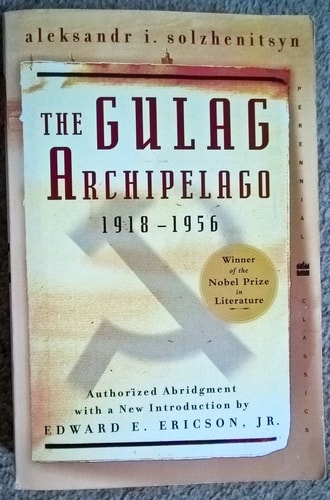
The Gulag Archipelago: 1918-1956
0
0
As an Amazon Associate and affiliate partner, Menrva Books earns from qualifying purchases. Learn more
Author Description
Drawing on his own incarceration and exile, as well as on evidence from more than 200 fellow prisoners and Soviet archives, Aleksandr I. Solzhenitsyn reveals the entire apparatus of Soviet repression -- the state within the state that ruled all-powerfully.Through truly Shakespearean portraits of its victims -- men, women, and children -- we encounter secret police operations, labor camps and prisons; the uprooting or extermination of whole populations, the "welcome" that awaited Russian soldiers who had been German prisoners of war. Yet we also witness the astounding moral courage of the incorruptible, who, defenseless, endured great brutality and degradation. The Gulag Archipelago 1918-1956 -- a grisly indictment of a regime, fashioned here into a veritable literary miracle -- has now been updated with a new introduction that includes the fall of the Soviet Union and Solzhenitsyn's move back to Russia.
Menrva's Summary
THE THESIS
This work investigates the structural mechanics and human cost of the Soviet forced labor camp system, known as the Gulag, between 1918 and 1956. Aleksandr I. Solzhenitsyn, a former prisoner of the Soviet state, synthesizes his personal experience with extensive testimonies from over 200 fellow inmates and archival research. He argues that the Gulag was not an aberration but a central, foundational apparatus of the Soviet state, designed to maintain control through systematic repression and the dehumanization of its citizenry.
THE SCOPE MAP
What You Will Find
- Detailed accounts of secret police operations and interrogation techniques
- Analysis of the labor camp infrastructure and prison hierarchy
- Documentation of the mass displacement and extermination of populations
- First-hand narratives of soldiers returning from German captivity to Soviet imprisonment
Scope Limits
- The text focuses primarily on the Soviet Union and does not provide a comparative analysis of contemporary prison systems in other nations.
THE AUTHORITY PERSPECTIVE
Historians and political scientists recognize this work as a foundational text for understanding the scale of Soviet-era repression. Readers frequently note the immense density of the prose and the harrowing nature of the documented accounts.
Page Count:
512
Publication Date:
2002-02-01
Publisher:
Harper Perennial Modern Classics
ISBN-10:
0060007761
ISBN-13:
9780060007768
History
Memoir
Biography
Literature & Fiction
Human rights
Europe
Criticism history
Historical
Soviet History
Authors
Community Tags
Similar Books