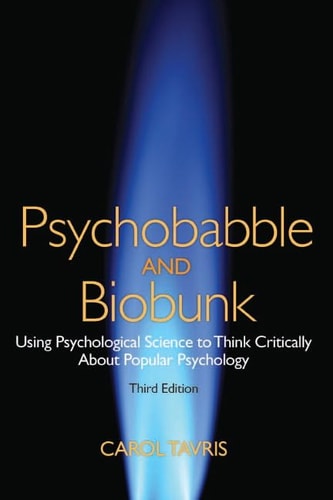
Psychobabble and Biobunk: Using Psychological Science to Think Critically About Popular Psychology
0
0
As an Amazon Associate and affiliate partner, Menrva Books earns from qualifying purchases. Learn more
Author Description
This revised and updated handbook features a selection of essay-style book reviews by Carol Tavris, written for the Times Literary Supplement, The Chronicle of Higher Education, American Scientist, and The New York Times Book Review. These reviews apply psychological research and principles of scientific thinking to ideas presented in the books. They aim to show how critical thinking can help people assess arguments promoted in the popular culture, and how to separate those that are scientifically sound from those based on “psychobabble”–pop-psych notions dressed up in fancy, sciency-sounding language. These essays may be used to encourage debate in the classroom or as a basis for student papers. Students can be asked to write or present their own points of view on a topic, drawing on other research and the guidelines of critical thinking (defined and described in a prefatory “Note to the Reader”) to support their conclusions. Although these reviews can be used in many social science and composition courses, the topics covered and the critical-thinking guidelines that apply to them correspond to specific material in Carole Wade and Carol Tavris’s Psychology and Invitation to Psychology.
Menrva's Summary
THE THESIS
This collection investigates the boundary between empirical psychological science and the pervasive influence of pseudoscientific 'psychobabble' in popular culture. Carol Tavris, a social psychologist and writer, utilizes her expertise to evaluate various books through the lens of scientific rigor. By applying principles of critical thinking, she provides a framework for readers to distinguish between evidence-based psychological research and unsubstantiated claims that rely on jargon to appear credible.
THE SCOPE MAP
What You Will Find
- A curated selection of essay-style book reviews originally published in academic and literary journals.
- A foundational 'Note to the Reader' that outlines specific guidelines for critical thinking and scientific evaluation.
- Analysis of popular psychology trends and their alignment with established psychological research.
- Pedagogical tools designed to facilitate classroom debate and student research projects.
THE AUTHORITY PERSPECTIVE
Experts and educators frequently cite this text as a practical resource for teaching students how to deconstruct popular media claims using scientific methodology. Readers note that the prose is accessible yet maintains a high standard of academic scrutiny, making it a useful supplement for introductory psychology curricula.
Page Count:
120
Publication Date:
2010-10-22
Publisher:
Pearson
ISBN-10:
0205015913
ISBN-13:
9780205015917
Science
Psychology
Essays
Education
Critical thinking
Psychotherapy
Community Tags
Similar Books
![Reason in the Balance: An Inquiry Approach to Critical Thinking [Paperback]](https://storage.googleapis.com/menrva_img_storage/covers/9780070073418.jpg)