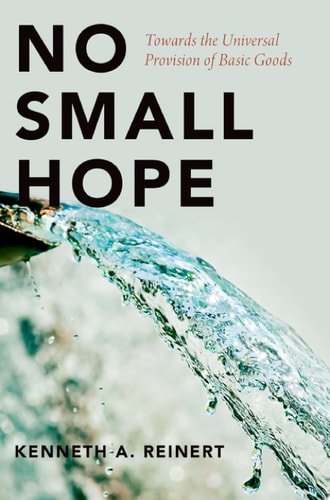
No Small Hope: Towards the Universal Provision of Basic Goods
0
0
As an Amazon Associate and affiliate partner, Menrva Books earns from qualifying purchases. Learn more
Author Description
With headlines focused on human suffering-civil wars, refugee flows, the spread of disease due to hunger and poor sanitation, population growth, climate change-it is easy to dive into despair. What is needed, instead, is a radical rethinking of global policy to realize the potential for improving the human condition.This book provides hope by examining the basic needs for a fundamental shift in thinking about development and human security for both practical and ethical reasons. Kenneth A. Reinert calls for a basic goods approach that focuses on the provision of nutritious food, clean water, sanitation, health services, education services, housing, electricity, and human security services. This approach bridges two perspectives: that of standard growth, which emphasizes increasing GDP per capita, and that of capabilities/human development, which puts priority on the realization of human potential. Reinert argues that only when growth leads to an increase in the broad-based provision of basic goods and services will the hoped-for expansion of human capabilities and development be achieved.No Small Hope places the basic goods approach on the firm foundation of objective human needs and subsistence rights. It offers a practical agenda for making progress towards human development by focusing on the real determinants of human well-being in an ethical system of moral minimalism. In a world of climate change, increased risk of natural disasters and increased refugee flows, the basic goods approach promises to help alleviate ongoing suffering and address vast deprivations in basic needs fulfillment.
Menrva's Summary
THE THESIS
Can a shift toward the universal provision of basic goods reconcile economic growth with the ethical imperative to improve human security and development? Kenneth A. Reinert, a professor of public policy, utilizes economic theory and human development frameworks to argue that standard GDP-focused growth is insufficient for addressing global deprivation. He proposes a 'basic goods' approach that prioritizes the tangible fulfillment of subsistence rights—such as clean water, housing, and health services—as the primary metric for successful development policy.
THE SCOPE MAP
What You Will Find
- A comparative analysis of GDP-based growth models versus capabilities-based human development frameworks.
- A defined list of essential goods and services required for human security, including sanitation, electricity, and education.
- An ethical argument for moral minimalism as a foundation for international policy.
Scope Limits
- The text does not provide a detailed country-by-country implementation manual for specific national governments.
- It does not focus on the technical mechanics of financial markets or private sector investment strategies.
THE AUTHORITY PERSPECTIVE
Experts recognize this work as a significant contribution to the discourse on development economics, particularly for its synthesis of ethical philosophy and practical policy. Readers frequently note the clarity of the author's argument, which bridges the gap between abstract human rights theory and concrete economic objectives.
Page Count:
296
Publication Date:
2018-07-02
Publisher:
Oxford University Press
ISBN-10:
0190499443
ISBN-13:
9780190499440
Economics
Human rights
Public Policy
Social Science
BASIC Needs
Community Tags
Similar Books