Giorgio de Chirico 1888-1978: Der moderne Mythos
0
0
As an Amazon Associate and affiliate partner, Menrva Books earns from qualifying purchases. Learn more
Author Description
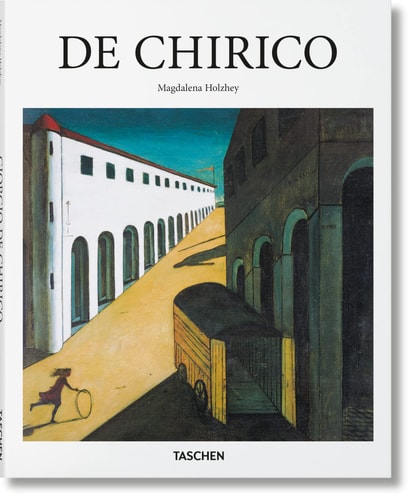
Pittura Metafisica The brooding spaces of Giorgio de Chirico With his Pittura Metafisica, Greek-born Italian painter Giorgio de Chirico (1888–1978) was a major influence in Europe’s interwar avant-garde, hailed by the likes of Pablo Picasso and Paul Éluard. The artist’s Pittura Metafisica set statues or mannequin-like figures in exaggerated one-point perspective spaces including city squares, receding arcades, distant walls, or claustrophobic interiors. Sharp perspectives, striking shadows, geometrical planes, and voids of space crafted a compositional drama and lurking mood of anxiety and loneliness.The paintings set out to disquiet, to make the viewer reassess the nature of reality and search beneath its appearances for elusive memories and unexpected insights. While the Surrealists around Breton turned to Freud’s theories of the unconscious, de Chirico was fascinated by Nietzsche. This dependable artist introduction explores all the ominous shadows and brooding corners of de Chirico’s Pittura Metafisica as well as his later development into a more classical style, a shift widely criticized by the Surrealists who had so admired his early paintings.“In the shadow of a man who walks in the sun, there are more enigmas than in all religions, past, present and future.” — Giorgio de Chirico About the Author Magdalena Holzhey studied art history, Italian, and musicology in Berlin and Pisa. She has held academic and curatorial positions in galleries and museums, including the K20 Kunstsammlung Nordrhein-Westfalen in Düsseldorf. She has published on classical modernism and contemporary art and is currently preparing a dissertation on Joseph Beuys.
Menrva's Summary
THE THESIS
This book investigates the profound influence of Giorgio de Chirico's 'Pittura Metafisica' on the European avant-garde and his subsequent stylistic evolution. Magdalena Holzhey, an art historian with experience in major galleries and museums, explores de Chirico's signature style characterized by unsettling, dreamlike cityscapes, exaggerated perspectives, and mannequin-like figures. The author examines how de Chirico's work, inspired by Nietzsche, aimed to disquiet viewers and prompt a re-evaluation of reality, contrasting this with the later Surrealist movement's embrace of Freudian theories. The book also addresses de Chirico's controversial shift towards a more classical style, which alienated his earlier admirers.
THE SCOPE MAP
- Exploration of Giorgio de Chirico's 'Pittura Metafisica' and its impact on interwar European avant-garde movements.
- Analysis of de Chirico's compositional techniques: exaggerated perspective, striking shadows, geometrical planes, and use of voids.
- Discussion of the thematic elements in de Chirico's work, including anxiety, loneliness, and the search for hidden realities.
- Examination of de Chirico's philosophical influences, particularly Friedrich Nietzsche.
- Coverage of de Chirico's later development into a classical style and the critical reception of this shift.
- Biographical details of Giorgio de Chirico (1888-1978) and his interactions with prominent artists and writers like Picasso and Éluard.
- Insights into the author Magdalena Holzhey's academic and curatorial background in art history.
THE AUTHORITY PERSPECTIVE
This dependable artist introduction explores the ominous shadows and brooding corners of de Chirico’s Pittura Metafisica as well as his later development into a more classical style. The book is presented as an exploration of de Chirico's significant influence on the European avant-garde, particularly his 'Pittura Metafisica' style. It highlights the artist's unique compositional drama and the philosophical underpinnings of his work, contrasting his approach with that of the Surrealists. The author's academic credentials suggest a thorough and informed analysis of de Chirico's oeuvre and its critical reception.
Page Count:
12
Publication Date:
2017-01-01
Publisher:
TASCHEN
ISBN-10:
3836546035
ISBN-13:
9783836546034
Non-Fiction
Art
Biography
Modern Art
Art History
European Art
Community Tags
Similar Books