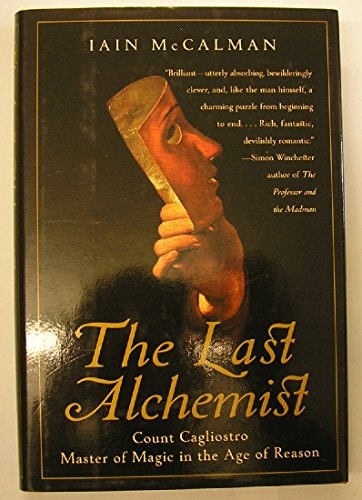
The Last Alchemist: Count Cagliostro, Master of Magic in the Age of Reason
0
0
As an Amazon Associate and affiliate partner, Menrva Books earns from qualifying purchases. Learn more
Author Description
Who was the mysterious Count Cagliostro? Depending on whom you ask, he was either a great healer and mystic or a dangerous charlatan whose revolutionary notions and influences threatened to undermine the monarchies of France and Russia. Whatever else he was, Count Alessandro di Cagliostro, the leader of an exotic brand of Freemasonry, was indisputably one of the most influential and notorious figures of the latter eighteenth century, overcoming poverty and an ignoble birth to become the darling -- and bane -- of upper-crust Europe.Internationally acclaimed historian Iain McCalman has not written a work of biography in the strictest sense; rather, he uses seven key "episodes" in Cagliostro's political and spiritual evolution to provide a dazzling panoramic portrait of eighteenth-century European culture and history. McCalman documents how Cagliostro crossed paths -- and often swords -- with the likes of Catherine the Great, Marie Antoinette, and Pope Pius VI. He was a muse to William Blake and the inspiration for both Mozart's The Magic Flute and Goethe's Faust. LouisXVI had him thrown into the Bastille for his alleged involvement in what would come to be known as "the affair of the necklace." Yet in London, Warsaw, and St. Petersburg, he established "healing clinics" for the poorest of the poor, a radical notion at that time; and his dexterity in the worlds of alchemy and spiritualism won him acclaim among the nobility across Europe.But it was his progress through the rites of Egyptian Freemasonry -- including the Illuminati, a genuinely conspiratorial secret society dedicated to the overthrow of established religion and monarchy -- that was both his highest achievement and his undoing. In 1791, on the order of Pope Pius VI, Cagliostro was arrested for heresy. He spent the last five years of his life in solitary confinement in an Italian prison, where he died in 1795.
Menrva's Summary
THE THESIS
This work investigates the life and influence of Count Alessandro di Cagliostro to determine whether he functioned as a genuine mystic or a calculated charlatan within the volatile political landscape of the late eighteenth century. Historian Iain McCalman utilizes a biographical framework structured around seven distinct episodes to analyze Cagliostro's rise from poverty to European notoriety. By examining his interactions with monarchs and his involvement in secret societies, the author argues that Cagliostro served as a mirror for the anxieties and intellectual shifts of the Enlightenment era.
THE SCOPE MAP
What You Will Find
- A detailed examination of eighteenth-century European social and political hierarchies.
- An analysis of the rise of Egyptian Freemasonry and its intersection with radical political movements.
- Historical accounts of the Affair of the Necklace and the subsequent trial by the Inquisition.
Scope Limits
- The text does not provide a comprehensive, chronological life history, focusing instead on thematic episodes.
- It does not attempt to definitively prove or disprove the validity of Cagliostro's alchemical claims.
THE AUTHORITY PERSPECTIVE
Historians and critics frequently note the author's ability to synthesize complex cultural history into a readable narrative. Experts highlight this text as a valuable study of the intersection between Enlightenment rationalism and the persistent allure of the occult in the late 1700s.
Page Count:
288
Publication Date:
2003-06-03
Publisher:
Harper
ISBN-10:
0060006900
ISBN-13:
9780060006907
Biography
History
European History
Freemasonry
Military
Italy
World
18th century
Europe
Historical
France
Occultism
Community Tags
Similar Books