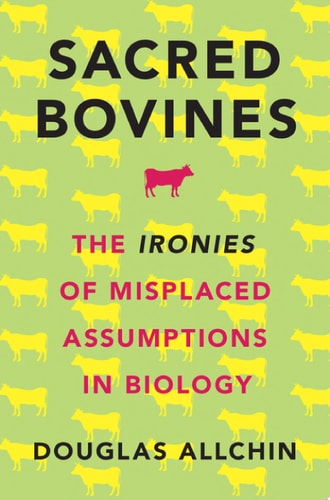
Sacred Bovines: The Ironies of Misplaced Assumptions in Biology
0
0
As an Amazon Associate and affiliate partner, Menrva Books earns from qualifying purchases. Learn more
Author Description
Some assumptions about biology are so deeply rooted in our thinking that they seem beyond question. These concepts - expressed in playful jargon - are our sacred bovines. With a light-hearted spirit, Douglas Allchin sets out to challenge many of these common beliefs about science and life. Allchin draws on fascinating insights from science to illustrate the ironies in many widespread beliefs.Be prepared to challenge the notion that male and female are fixed natural categories. Or that evolution implies cutthroat competition in human society. Or that we struggle against a fundamental immoral nature. Or that genes establish our identity. Or that science progresses through rare leaps of genius. Or that politics and emotions inevitably taint good science. Sacred Bovines revels in revelations about the nature of science.Reflecting on the many errors in commonly accepted, everyday ideas also fosters creative thinking. How do we challenge assumptions? How do we "think outside the box"? The many examples here provide inspiration and guidance, further elaborated in a retrospective epilogue. An additional "Afterword for Teachers" highlights how the essays can foster learning about the nature of science and describes some practical classroom strategies.
Menrva's Summary
THE THESIS
This book investigates the persistence of flawed assumptions in biological science and the mechanisms by which these misconceptions become entrenched as unquestioned truths. Douglas Allchin, an expert in the history and philosophy of science, utilizes a series of case studies to dismantle common biological myths. He argues that by identifying these errors, readers can cultivate a more nuanced understanding of scientific inquiry and the nature of evidence.
THE SCOPE MAP
What You Will Find
- Analysis of biological concepts such as genetic determinism, evolutionary competition, and gender binaries.
- Methodologies for identifying and challenging cognitive biases in scientific reasoning.
- Pedagogical strategies for educators to teach the nature of science through critical analysis.
Scope Limits
- The text does not provide a comprehensive history of biology but focuses specifically on debunking persistent myths.
- It does not offer a technical manual for laboratory research but rather a philosophical framework for scientific literacy.
THE AUTHORITY PERSPECTIVE
Educators and historians of science frequently cite this work as a valuable resource for teaching critical thinking and the philosophy of science. Readers note the accessible prose style, which effectively balances academic rigor with an engaging, inquisitive tone.
Page Count:
264
Publication Date:
2017-01-01
Publisher:
Oxford University Press
ISBN-10:
0190490381
ISBN-13:
9780190490386
Science
Philosophy of
Zoology
Professional Career & Trade
Biology
Education
Critical thinking
Community Tags
Similar Books