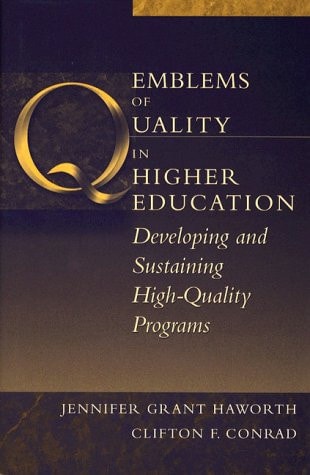
Emblems of Quality in Higher Education: Developing and Sustaining High-Quality Programs
0
0
As an Amazon Associate and affiliate partner, Menrva Books earns from qualifying purchases. Learn more
Author Description
There has been a growing public concern that the nation's colleges and universities are not preparing individuals adequately for the demanding challenges of tomorrow's workplace. Legislators, bombarded by taxpayer complaints about the rising costs of higher education, are pressuring colleges and universities to become more accountable through quality control and program review mandates. And declining financial support for higher education is forcing many institutions to look critically at programs to decide which merit continued funding.To be sure, post-secondary educators have always been concerned about the quality of their programs. But "quality" has often been defined in terms of faculty research or student test scores - measures that do not meet today's educational needs. This book challenges educators to reexamine their assumptions and beliefs about program quality. It offers a comprehensive theory of quality in higher education, organized around one central idea: that student learning is the focal point of a high-quality undergraduate or graduate program, and consequently that program quality is a result of student, faculty, and administrative engagement in mutually supportive teaching and learning.To ascertain the components of an academic program that is seen as successful by all those who have a stake in it, the authors examined the literature and analyzed interviews with 781 students, faculty, administrators, alumni, and employers of program graduates in a broad range of disciplines at a wide variety of colleges and universities. They identified seventeen specific factors, which they grouped into five clusters of attributes: diverse and engaged participants, a participatory culture, interactive teaching and learning, connected program requirements, and adequate resources. Supporting excerpts from the interviews illuminate the authors' detailed examination of these factors.
Menrva's Summary
THE THESIS
This book investigates how colleges and universities can redefine and sustain program quality by shifting the focus from traditional metrics like research output to the centrality of student learning. Authors Clifton Conrad and Jennifer Grant Haworth, both established scholars in higher education, utilize a robust empirical framework derived from extensive qualitative research. They argue that true program quality emerges from a collaborative environment where students, faculty, and administrators engage in mutually supportive teaching and learning processes.
THE SCOPE MAP
What You Will Find
- A comprehensive theory of quality centered on seventeen specific factors grouped into five distinct clusters of attributes.
- Analysis of 781 interviews with students, faculty, administrators, alumni, and employers across diverse disciplines and institutional types.
- A framework for evaluating programs based on participant engagement, participatory culture, interactive teaching, connected requirements, and resource allocation.
- Qualitative evidence provided through direct excerpts from stakeholders to illustrate the practical application of the proposed quality factors.
THE AUTHORITY PERSPECTIVE
The text provides a systematic, research-backed approach to academic program evaluation that remains relevant for administrators navigating modern accountability mandates. Its reliance on a large-scale interview dataset offers a grounded, practical perspective on the collaborative nature of educational success.
Page Count:
224
Publication Date:
1996-07-08
Publisher:
Allyn & Bacon
ISBN-10:
0205195466
ISBN-13:
9780205195466
Higher Education
Educational Policy
Teaching Methods
Education
Community Tags
Similar Books