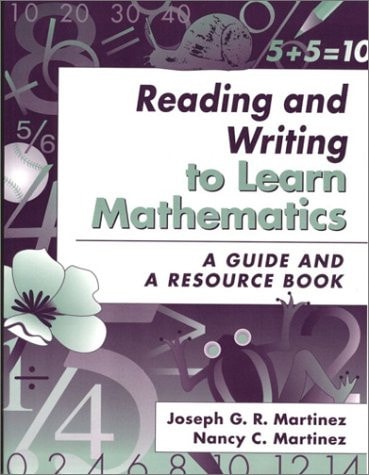
Reading and Writing to Learn Mathematics: A Guide and a Resource Book
0
0
As an Amazon Associate and affiliate partner, Menrva Books earns from qualifying purchases. Learn more
Author Description
Reading and Writing to Learn Mathematics responds directly to changing patterns of discourse in the mathematics classroom. The book shows how to teach math using writing and reading lessons and activities in accordance with NCTM standard #2, math-as-communication, which makes ideas clearer by placing complex mathematics concepts in meaningful contexts and helps the student make the transition to mathematical language. Writing to learn mathematics enhances the development of effective problem-solving strategies and inductive reasoning; promotes metacognition; and facilitates assessment by documenting the problem-solving process. Reading to learn mathematics helps break down barriers between mathematics learning and learning across the curriculum. As children become better math readers, they develop cognitive structures and contexts for processes and procedures. This book includes classroom examples, lessons, activities, and stories for teachers to show how everyday language skills can transfer to math learning. The authors illustrate how to make writing a meaningful part of cognitive as well as affective development, how to use reading and writing in assessment of math sills and how to make reading-math assignments more meaningful. This book emphasizes practical, innovative ideas for integrating reading and writing into the K-6 mathematics curriculum. For K-6 preservice and inservice teachers who wish to incorporate writing and reading more effectively into their math curriculum.
Menrva's Summary
THE THESIS
How can educators effectively integrate reading and writing strategies into the K-6 mathematics curriculum to improve student comprehension and communication? Joseph G. R. Martinez and Nancy C. Martinez provide a pedagogical framework designed to align with NCTM standards regarding mathematics as a form of communication. By leveraging language arts skills, the authors argue that teachers can help students transition from everyday language to formal mathematical discourse while simultaneously enhancing problem-solving and metacognitive abilities.
THE SCOPE MAP
What You Will Find
- Practical classroom lessons and activities for K-6 mathematics instruction.
- Methodologies for using writing to document and assess the problem-solving process.
- Strategies for integrating reading to build cognitive structures for mathematical procedures.
- Approaches for aligning math instruction with broader cross-curricular literacy goals.
THE AUTHORITY PERSPECTIVE
This text serves as a specialized resource for preservice and inservice teachers seeking to bridge the gap between linguistic development and quantitative reasoning. The focus on practical application and alignment with established educational standards makes it a structured guide for classroom implementation.
Page Count:
242
Publication Date:
2000-11-26
Publisher:
Allyn & Bacon
ISBN-10:
020530284X
ISBN-13:
9780205302840
Teaching Methods
Literacy
Mathematics
Pedagogy
Education
Technical Writing
Community Tags
Similar Books