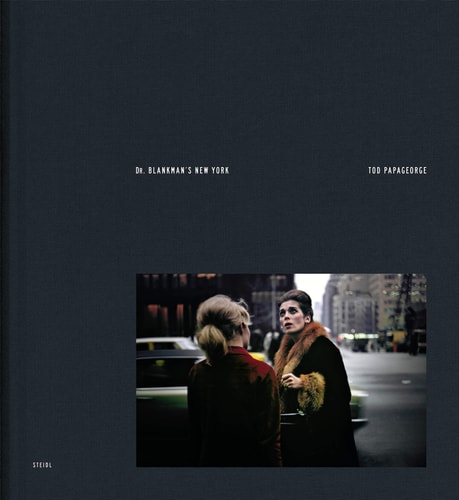
Dr. Blankman's New York Kodachromes 1966-1967
0
0
As an Amazon Associate and affiliate partner, Menrva Books earns from qualifying purchases. Learn more
Author Description
Tod Papageorge: Dr. Blankman ́s New York documents a brief but critical moment in the photographer's early career, the two years Papageorge shot in color in New York in the late 1960s. Black-and-white photography was still the "serious" medium, and color reserved for commercial applications; Papageorge--25 years old and newly arrived in New York City--was encouraged by his fellow photographers to seek paying magazine work by developing a body of work in color. In some ways it was a failed experiment: Papageorge mostly approached color in the same way as he approached black and white, except that he also began to intuitively produce still-life pictures with little commercial appeal, spotlighting canned hams in shop windows and political posters. But color offered Papageorge the opportunity to work in a new medium at a time of great social, political and cultural change. "I'd like to think that, in Dr. Blankman ́s New York, you'll find a persuasive account of what it meant for me to be free with a Leica in the streets of my newly adopted home of Manhattan," writes Papageorge, "a record drawn with Kodachrome film and its rich, saturated colors." Tod Papageorge (born 1940) picked up photography for the first time as a student at the University of New Hampshire. He is the recipient of two Guggenheim Fellowships and two National Endowment for the Arts Fellowships. From 1979 to 2013 Papageorge served as Yale University's Walker Evans Professor of Photography and Director of Graduate Study in Photography.
Menrva's Summary
THE THESIS
This book documents a pivotal, albeit brief, period in the early career of photographer Tod Papageorge, focusing on his two years shooting in color in New York City during the late 1960s. At a time when black-and-white photography was considered the serious medium and color was relegated to commercial applications, Papageorge, then 25 and newly arrived in Manhattan, was encouraged by peers to explore color for potential magazine work. While he approached the new medium similarly to his black-and-white work, he also began to intuitively create still-life images of limited commercial appeal, such as canned hams in shop windows and political posters. Nevertheless, color provided Papageorge with an avenue to engage with a new medium amidst significant social, political, and cultural transformations.
THE SCOPE MAP
- Exploration of Tod Papageorge's early color photography from 1966-1967.
- Focus on Papageorge's experiences and artistic choices in New York City during a period of social change.
- Discussion of the prevailing attitudes towards color versus black-and-white photography in the late 1960s.
- Analysis of Papageorge's intuitive still-life compositions, including images of canned hams and political posters.
- Papageorge's personal reflections on freedom and creativity with a Leica on the streets of Manhattan.
- Use of Kodachrome film and its characteristic rich, saturated colors as a key element.
- Contextualization of the work within the broader social, political, and cultural shifts of the era.
THE AUTHORITY PERSPECTIVE
This collection is recognized for its insightful documentation of a specific, formative period in Tod Papageorge's photographic career. The work is noted for capturing the spirit of New York City in the late 1960s through the lens of a photographer navigating the artistic and commercial expectations of the time. The use of Kodachrome film and its distinctive color palette is highlighted as a significant aspect of the visual narrative. The book offers a persuasive account of Papageorge's artistic freedom and his engagement with a rapidly changing urban landscape.
Page Count:
136
Publication Date:
2017-01-01
Publisher:
Steidl
ISBN-10:
3958291082
ISBN-13:
9783958291089
Photography
Non-Fiction
Art History