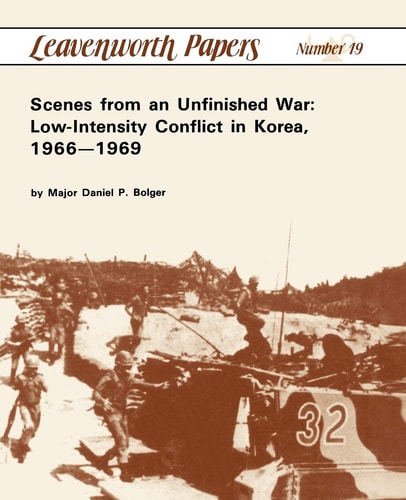
Scenes from an Unfinished War: Low-Intensity Conflict in Korea, 1966-1969
0
0
As an Amazon Associate and affiliate partner, Menrva Books earns from qualifying purchases. Learn more
Author Description
Low-intensity conflict (LIC) often has been viewed as the wrong kind of warfare for the American military, dating back to the war in Vietnam and extending to the present conflicts in Iraq and Afghanistan. From the American perspective, LIC occurs when the U.S. military must seek limited aims with a relatively modest number of available regular forces, as opposed to the larger commitments that bring into play the full panoply of advanced technology and massive commitments of troops. Yet despite the conventional view, U.S. forces have achieved success in LIC, albeit "under the radar" and with credit largely assigned to allied forces, in a number of counterguerrilla wars in the 1960s. "Scenes from an Unfinished War: Low-Intensity Conflict in Korea, 1966-1969" focuses on what the author calls the Second Korean conflict, which flared up in November 1966 and sputtered to an ill-defined halt more than three years later. During that time, North Korean special operations teams had challenged the U.S. and its South Korean allies in every category of low-intensity conflict - small-scale skirmishes along the Demilitarized Zone between the two Koreas, spectacular terrorist strikes, attempts to foment a viable insurgency in the South, and even the seizure of the USS Pueblo - and failed. This book offers a case study in how an operational-level commander, General Charles H. Bonesteel III, met the challenge of LIC. He and his Korean subordinates crafted a series of shrewd, pragmatic measures that defanged North Korea's aggressive campaign. According to the convincing argument made by "Scenes from an Unfinished War", because the U.S. successfully fought the "wrong kind" of war, it likely blocked another kind of wrong war - a land war in Asia. The Second Korean Conflict serves as a corrective to assumptions about the American military's abilities to formulate and execute a winning counterinsurgency strategy. Originally published in 1991. 180 pages. maps. ill.
Menrva's Summary
THE THESIS
This book investigates the effectiveness of low-intensity conflict (LIC) strategies employed by U.S. forces in Korea between 1966 and 1969. It examines how General Charles H. Bonesteel III and his Korean subordinates countered North Korean special operations, including skirmishes along the Demilitarized Zone, terrorist attacks, insurgency attempts, and the USS Pueblo seizure. The work argues that the successful management of this
THE SCOPE MAP
- Analysis of the Second Korean Conflict (1966-1969) as a case study in low-intensity conflict.
- Examination of North Korean special operations tactics and their failure to achieve objectives.
- Detailed look at the command strategies of General Charles H. Bonesteel III and his Korean counterparts.
- Assessment of the U.S. military's ability to succeed in counterguerrilla warfare.
- Discussion of how successful LIC in Korea may have prevented a larger land war in Asia.
- Case study on formulating and executing effective counterinsurgency strategies.
THE AUTHORITY PERSPECTIVE
The book presents a detailed case study of low-intensity conflict in Korea, focusing on the strategic and tactical responses to North Korean aggression. It argues that the successful management of this "wrong kind" of war by U.S. forces prevented a larger conflict in Asia. The work serves as a corrective to assumptions about the U.S. military's capabilities in counterinsurgency. The analysis highlights the pragmatic measures employed by operational-level commanders and their subordinates.
Page Count:
178
Publication Date:
2011-01-01
Publisher:
www.Militarybookshop.CompanyUK
ISBN-10:
178039005X
ISBN-13:
9781780390055
History
Non-Fiction
Korean War
Cold War
Counterinsurgency
Military History
Community Tags
Similar Books
Reader Comments
Share Your Thoughts
No comments yet. Be the first to share your thoughts!