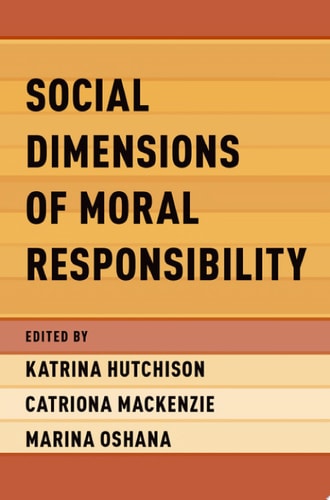
Social Dimensions of Moral Responsibility
0
0
As an Amazon Associate and affiliate partner, Menrva Books earns from qualifying purchases. Learn more
Author Description
To what extent are we responsible for our actions? Philosophical theorizing about this question has recently taken a social turn, marking a shift in focus from traditional metaphysical concerns about free will and determinism. Recent theories have attended to the interpersonal dynamics at the heart of moral responsibility practices and the role of the moral environment in scaffolding agency. Yet, the implications of social inequality and the role of social power for our moral responsibility practices remains a surprisingly neglected topic. The conception of agency involved in current approaches to moral responsibility is overly idealized, assuming that our practices involve interactions between equally empowered and situated agents.In twelve new essays and a substantial introduction, this volume systematically challenges this assumption, exploring the impact of social factors such as power relationships and hierarchies, paternalism, socially constructed identities, race, gender and class on moral responsibility. Social factors have bearing on the circumstances in which agents act as well as on the person or people in the position to hold that agent accountable for his or her action. Additionally, social factors bear on the parties who pass judgment on the agent.Leading theorists of moral responsibility, including Michael McKenna, Marina Oshana, and Manuel Vargas, consider the implications of oppression and structural inequality for their respective theories. Neil Levy urges the need to refocus our analyses of the epistemic and control conditions for moral responsibility from individual to socially extended agents. Leading theorists of relational autonomy, including Catriona Mackenzie, Natalie Stoljar and Andrea Westlund develop new insights into the topic of moral responsibility. Other contributors bring debates about moral responsibility into dialogue with recent work in feminist philosophy, social epistemology and social psychology on topics such as epistemic inju
Menrva's Summary
THE THESIS
This volume investigates how social power, inequality, and structural hierarchies fundamentally reshape the traditional philosophical understanding of moral responsibility. The editors, Catriona Mackenzie, Katrina Hutchison, and Marina A. L. Oshana, curate a collection of twelve essays that challenge the idealized, individualistic models of agency prevalent in contemporary ethics. By integrating perspectives from feminist philosophy, social epistemology, and psychology, the contributors argue that moral accountability cannot be divorced from the social environments and power dynamics in which agents are situated.
THE SCOPE MAP
What You Will Find
- Analysis of how social factors like race, gender, and class influence moral judgment.
- Theoretical frameworks for understanding agency within oppressive or unequal social structures.
- Critiques of traditional metaphysical approaches to free will and determinism.
- Integration of relational autonomy theory with moral responsibility discourse.
Scope Limits
- The text does not provide a comprehensive history of moral philosophy.
- It does not offer a singular, unified theory of responsibility, but rather a collection of diverse critical perspectives.
THE AUTHORITY PERSPECTIVE
Experts identify this collection as a significant intervention in contemporary ethics, specifically for its focus on the intersection of social power and agency. Readers frequently note the academic density of the prose, characterizing it as a specialized resource for scholars and advanced students of moral philosophy.
Page Count:
360
Publication Date:
2018-04-11
Publisher:
Oxford University Press
ISBN-10:
0190609613
ISBN-13:
9780190609610
Philosophy
Responsibility
Ethics
Feminist Philosophy
Social Philosophy
Community Tags
Similar Books














Reader Comments
Share Your Thoughts
No comments yet. Be the first to share your thoughts!